


















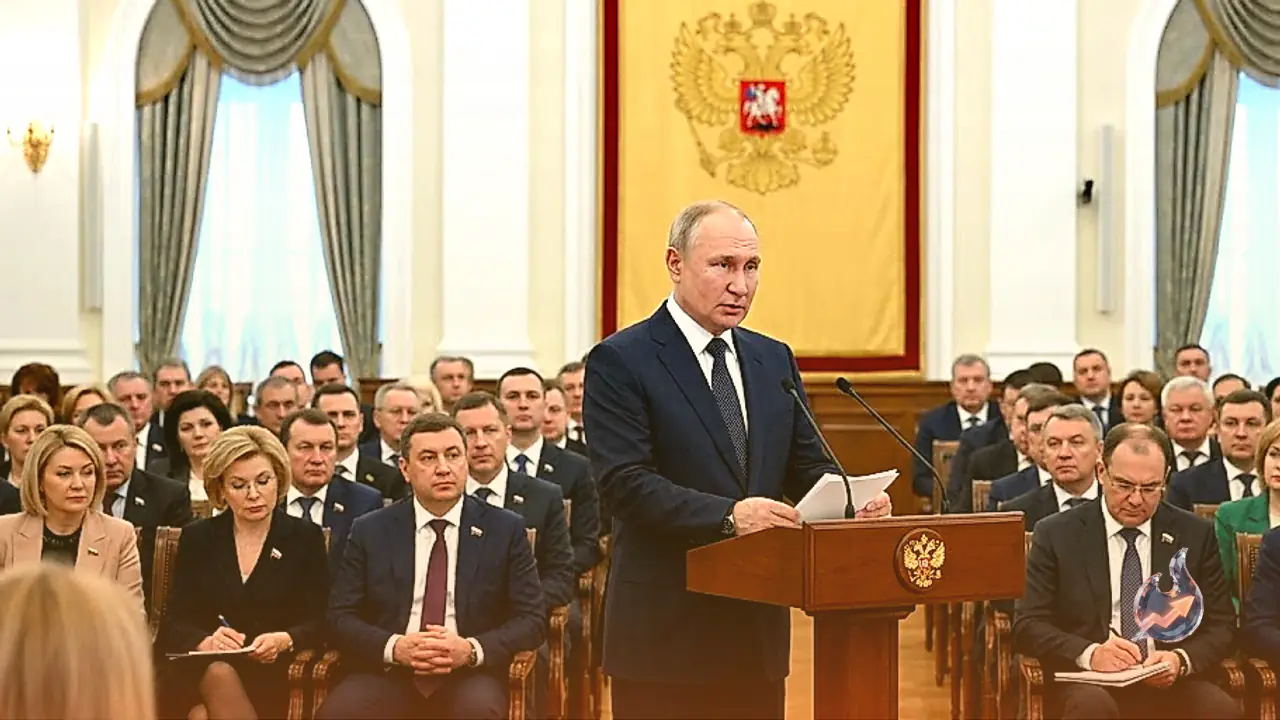

During a major parliamentary address in Moscow, Russian President Vladimir Putin reaffirmed his administration's commitment to national security, sovereignty, and the ongoing military campaign in Ukraine. Speaking on Monday to lawmakers of the eighth convocation of the State Duma, the Russian leader asserted that all predefined goals would be fully realized. Expressing confidence in national unity, he emphasized that the country stands collective in preserving its independence and strategic security, while heavily criticizing Western nations for perceived double standards and economic sanctions.
Vladimir Putin Reaffirms Military Objectives and State Sovereignty
In his address to the eighth convocation of the State Duma, Vladimir Putin stated that safeguarding national borders and state sovereignty remains the highest priority for the Russian Federation. He expressed conviction that the armed forces and the public would together navigate all external challenges to secure victory. Describing the past five years as exceptionally demanding and pivotal for the nation's history, he acknowledged that this timeframe tested the resilience of both the state and its citizens.
The Russian President commended the parliamentarians for their legislative efforts in fortifying the country's sovereign foundations and protecting national interests. Paying tribute to service members engaged in the Special Military Operation, he underscored that those fighting on the frontlines carry the overwhelming backing of the entire society. Drawing historical parallels, he noted that Russia has consistently demonstrated solidarity whenever confronted by external threats, a collective resolve that continues to define the nation today.
Accusations Against Western Nations: Sanctions and Alleged Double Standards
Reflecting on international relations, Vladimir Putin leveled sharp criticisms at Western governments regarding their application of global legal frameworks. He accused Western powers of displaying a hypocritical stance toward the United Nations Charter, interpreting principles such as self-determination strictly when advantageous to their own geopolitical interests. He pointed out that despite unprecedented volumes of sanctions and widespread Russophobic campaigns initiated since 2022, these economic and political measures failed to accomplish their intended outcomes.
He further alleged that after failing to secure a military defeat against Russia on the battlefield, adversarial forces turned toward open terror tactics directed at the civilian population. However, he maintained that the Russian public cannot be intimidated or broken, stating that such attempts have historically failed and will continue to fail. He defended Russia's constitutional order and political institutions, describing them as structurally sound and fully equipped to withstand any external pressure.
Volodymyr Zelenskyy Meets Donald Trump in Washington for Peace Talks
These statements coincide with a critical juncture in the conflict, characterized by continued hostilities alongside renewed diplomatic maneuvering. While Western powers maintain military assistance to Kyiv and enforce sanctions against Moscow, Ukrainian President Volodymyr Zelenskyy has arrived in the United States. His scheduled meeting with President Donald Trump at the White House is expected to focus on potential avenues for ending the war and establishing a framework for peace negotiations.
A White House official noted that the time has arrived to bring the military confrontation to a conclusion. Concurrently, Donald Trump dismissed claims alleging that Russia had been sharing intelligence concerning U.S. military bases with Iran. Donald Trump stated he does not believe Moscow is engaging in such intelligence transfers, particularly not on any significant scale.
Polish Minister Claims PM Modi Intervened to Prevent Nuclear Strike
Adding to the broader geopolitical narrative, a minister from Poland made a notable assertion regarding nuclear security during the conflict. According to the Polish official, Russian President Vladimir Putin was previously considering a nuclear strike in Ukraine, but the intervention of Indian Prime Minister Narendra Modi successfully averted the potential attack. This statement emerges as international actors continue monitoring security dynamics across the region while seeking diplomatic solutions to end the ongoing war.