






















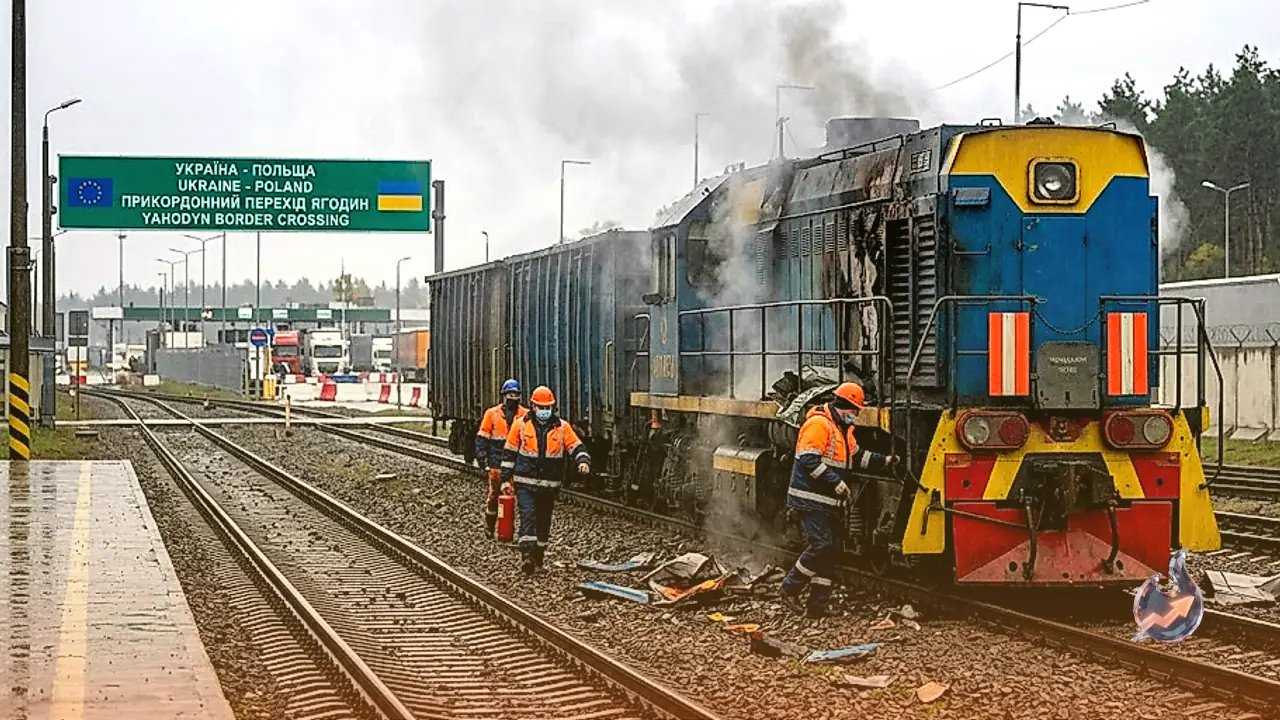

A Russian jet-propelled drone struck a train locomotive at Yahodyn railway station near the Ukraine-Poland border, just after former UK Prime Minister Boris Johnson and a delegation of senior European national security officials travelled through the route. The international figures, including the UK's Jonathan Powell, were returning on a different train from Kyiv after attending the annual Yalta European Strategy conference. The strike heavily damaged the train's engine, but disaster was averted as all passengers had already been evacuated following urgent security warnings, Ukrainian officials reported.
Strike Occurred Two Kilometres From NATO Frontier
Official confirmations from Ukrainian and Polish authorities revealed that the Russian drone hit its target merely 2km (1.2 miles) from the border with Poland. The incident took place at Yahodyn, causing alarm along the international frontier. Ukraine's state rail operator Ukrzaliznytsia stated that an evacuation order for passengers aboard the targeted train had been issued just 15 minutes before the jet-powered drone impacted the locomotive. The swift response ensured that no casualties were reported, even though the blast destroyed the engine unit.
Suspicions Mount Over Diplomatic Target
Ukrzaliznytsia raised strong concerns regarding Moscow's true intention, suggesting that the strike could quite possibly have been aimed at the diplomatic train carrying the foreign delegation. According to the state railway company, the diplomatic convoy had departed Yahodyn earlier than originally planned due to an abrupt timetable revision prompted by ongoing threats of Russian aerial strikes. While Russia acknowledged launching strikes against railway infrastructure in western Ukraine, the timing has intensified suspicion among security analysts.
Eyewitness Accounts From High-Profile Travellers
Former CIA director David Petraeus, who was travelling on another train halted at Yahodyn station during the strike, described the event as terrifying. Speaking to the New York Times, David Petraeus said that this was the act of a truly barbaric leader trying to terrorize Ukrainian civilians. Former Swedish Prime Minister Carl Bildt, who also participated in the Kyiv summit, recounted that passengers on his train received orders to prepare for immediate evacuation after their train came to an abrupt halt. He explained that after several minutes, travellers were notified that the danger had passed and they were cleared to continue their route, eventually reaching the Polish border station of Dorohusk safely. While speculation surfaced that Carl Bildt shared a train with Boris Johnson, the former British prime minister did not verify those details.
Johnson and Kyiv Demand Decisive Action
Reacting publicly to the incident on X, Boris Johnson condemned the bombing of civilian transit infrastructure. He stated that he did not understand the warped logic driving Vladimir Putin to destroy a stationary Ukrainian locomotive on the Polish border, calling it the type of random and senseless assault Ukrainian civilians face every single day. Boris Johnson urged Western allies to accelerate the delivery of essential air defence equipment to protect the nation's rail routes and cities. Ukraine has repeatedly pressed international partners, notably the United States, for interceptors capable of neutralising high-speed ballistic missiles and jet-powered drones.
Poland and EU Sound Alarm on Border Proximity
Ukrainian Foreign Minister Andrii Sybiha warned that the Yahodyn attack amounted to Vladimir Putin's terror knocking directly on the doors of the EU and NATO. He called for significantly stronger sanctions against Russia, asserting that Vladimir Putin must face decisive measures that elevate the financial and strategic cost of warfare beyond an acceptable threshold. Across the border, Polish Prime Minister Donald Tusk convened an urgent cabinet meeting, noting that Russian escalation is turning into an immediate reality that edges ever closer to Polish territory.
Systematic Assaults on Ukrainian Transport Networks
The Yahodyn attack highlights a growing trend of strikes aimed at Ukrainian transit points, border terminals, and civilian transport hubs. Because Ukrainian airspace has remained entirely closed to commercial aviation since Russia launched its full-scale invasion in 2022, the railway network managed by Ukrzaliznytsia serves as the principal lifeline for passenger and supply movements across the country. Earlier in the week, Ukrainian President Volodymyr Zelensky confirmed that two people were killed when Russian drones struck a crossing between Ukraine and Moldova. Days prior, a drone strike on a passenger service in southern Ukraine killed a female conductor, while a missile attack on a railway depot in Kyiv claimed the lives of six railway personnel earlier this month. In January, Volodymyr Zelensky strongly condemned another strike that killed five people on a crowded passenger train in the northeastern Kharkiv province.
Widening European Concerns Over Sabotage and Incidents
The close proximity of the Yahodyn attack to NATO territory coincides with an increase in unexplained infrastructure incidents across mainland Europe. German authorities recently attributed an August drone incident at Leipzig airport to Russian operations, an accusation Moscow dismissed as absurd. Furthermore, multiple unexplained blazes and disruptions have hit defence manufacturing facilities and industrial sites stretching from Italy to Estonia, prompting impacted governments to openly investigate potential Russian covert actions. The bombing at the Polish border adds fresh urgency to concerns regarding cross-border conflict spillover.