
















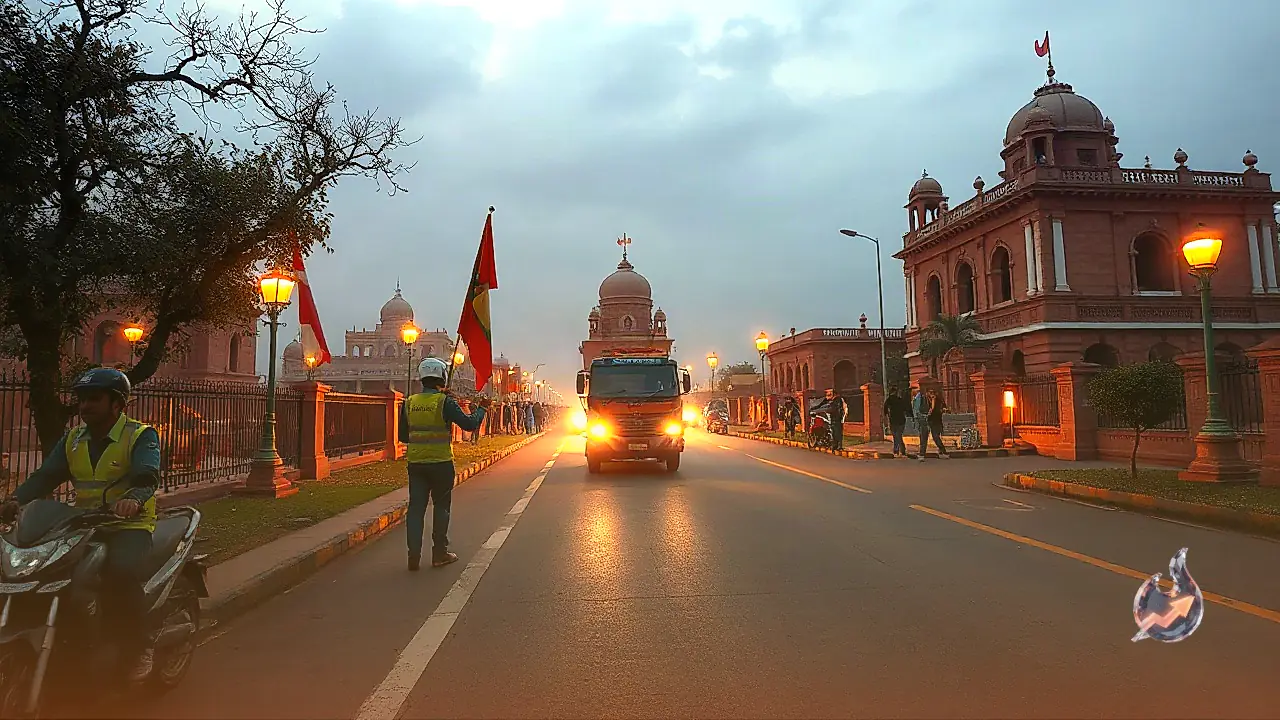

Madhya Pradesh has officially revived its public road transport network after a gap of more than two decades, replacing obsolete mechanisms with a technologically advanced, eco-friendly transit ecosystem. During a high-profile ceremony held at the BHEL Dussehra Maidan in Bhopal, the state inaugurated both the Mukhyamantri Sugam Parivahan Seva and the PM E-Bus Seva. Union Minister for Road Transport and Highways Nitin Gadkari and Chief Minister Dr. Mohan Yadav jointly flagged off an introductory fleet of 351 buses serving intercity and intracity corridors. Rolled out under the state's Mobility Vision 2030 framework, the initiative seeks to establish modern, affordable, and safe passenger transport across urban and rural belts. Following the formal inaugurations, the Chief Minister purchased a ticket alongside other public representatives to take part in the inaugural ride.
Initial Phase Deployment Across Seven Urban Centres
The first phase of the state transport service concentrates on seven strategically selected cities: Indore, Bhopal, Jabalpur, Rewa, Dewas, Katni, and Bhind. The initial fleet of 351 vehicles is partitioned into 120 intercity buses handling point-to-point connections between distinct regional hubs and 231 intracity buses catering to commuting traffic inside municipal limits.
The deployment allocation directly addresses the commuter volumes of these destinations. Indore, the primary commercial metropolis of the state, receives the largest share with 145 operational buses, consisting of 50 intercity and 95 intracity units. The capital city of Bhopal has been allocated 106 buses, comprising 23 intercity and 83 intracity vehicles. Jabalpur gains 67 buses, split into 14 intercity and 53 intracity carriers. The eastern district of Rewa receives 18 intercity buses, Dewas is granted 10 intercity buses, Katni gets 3 intercity buses, and Bhind is assigned 2 intercity buses. Earlier in the day, leaders also laid floral tributes at the statue of Pandit Deendayal Upadhyaya at Lalghati and planted saplings to promote green values.
Smart Fleet Management and Commuter Safety Upgrades
The newly inducted fleet incorporates comprehensive automated tracking and passenger security hardware. Operational timings, bus locations, and route adherence will be supervised round the clock through an Intelligent Transport Management System (ITMS). Central command and control rooms have been made operational under Madhya Pradesh Yatri Parivahan Infrastructure Limited alongside its seven municipal subsidiary arms to coordinate field dispatch in real time.
Commuter safety protocols heavily prioritize the protection of women and minors. Every bus comes equipped with closed-circuit surveillance cameras, dedicated emergency panic buttons, and vehicle location tracking modules. A centralized passenger information system provides riders with live timetable updates and route status. Drivers are being mandated to undergo structured technical training focused on road safety protocols. Alongside physical features, digital ticketing and automated grievance resolution frameworks have been instituted to deter overcharging and route deviations.
Target of 15,000 Buses by 2031 and Collaborative Partnerships
The state government has blueprinted a multi-stage expansion roadmap to progressively swell the public transport fleet over the next decade. While the opening year establishes a baseline of 1,500 operational buses, the state intends to induct roughly 2,500 to 3,000 buses annually thereafter. The long-term target envisions deploying 15,000 passenger buses across the state by the year 2031. Furthermore, by 2029, a standardized fleet of saffron-colored buses is slated to ply more than 3,000 surveyed routes covering all 55 districts, providing direct inter-state links to major religious shrines and major national metropolises.
Execution of this transport initiative relies extensively on a Public-Private Partnership (PPP) model, engaging private fleet operators through structured concession terms and efficiency incentives. The approach seeks to upgrade regional depots, bus terminal stations, and charging hubs without overburdening the state treasury. Cementing research and operational design, MP Yatri Parivahan Company entered into formal memoranda of understanding with the Indian Institute of Management Indore and the School of Planning and Architecture Bhopal during the kickoff event.
Clean Fuels, Biofuels, and Electric Transit Economics
Transitioning toward carbon-neutral urban mobility emerged as a central fiscal and environmental theme. Union Minister Nitin Gadkari remarked, "The problem is not money; the problem is money not being spent." He detailed that the national PM E-Bus Seva scheme carries a total budgetary outlay of 57,000 crore rupees to deploy 10,000 electric buses nationwide, backed by 20,000 crore rupees in central government financial support. Madhya Pradesh has secured an allocation of 972 electric units under this central window, though regional expansion models foresee a requirement of nearly 25,000 electric air-conditioned buses to meet demand fully.
Discussing macroeconomic impacts, the Union Minister noted that the country incurs an import bill of 22 lakh crore rupees annually for petroleum, diesel, and natural gas. Transitioning to domestically produced electricity and agricultural ethanol keeps revenue within regional economies and converts farmers from food growers into energy suppliers through surplus maize processing. He observed that 4 crore four-wheelers and 20 crore two-wheelers in the country currently use fuel blends. The economic objective of large-scale electric bus deployment is to reduce passenger travel fares by up to 30 percent relative to traditional diesel options.
Driver Training Centers, Scrapping Units, and Road Infrastructure
The expansion of road transit is accompanied by institutional support for automotive logistics and technical skilling. Confronting a deficit of 22 lakh professional commercial drivers across the country, authorities have sanctioned 61 new driver training institutes in addition to the 29 centers already approved in the state. To oversee vehicular safety standards, authorization has been granted for 6 operational testing stations. The state currently hosts 8 vehicle scrapping facilities, with plans calling for 21 more to foster recycling industries and generate local employment in underprivileged districts. In coordinating road maintenance, the state's Public Works Department has integrated bus schedules into its Lokpath app, while temporary toll collection exemptions have been sanctioned at the Shahpura toll plaza.
Rural Inclusion and Regional Development Targets
Chief Minister Dr. Mohan Yadav declared, "A new chapter has been written in fulfilling the pledge of public service." He stressed that re-establishing the state-backed transit network after a 21-year hiatus directly advances social equity under the ongoing Seva Sankalp Month. The ultimate operational milestone is to connect 75 percent of the state's gram panchayats to scheduled bus links. Remote tribal belts, including districts such as Balaghat, stand to benefit from direct access to higher education, healthcare institutions, and economic hubs.
The Chief Minister reflected on administrative reforms, citing the previous dismantling of congested urban bus corridors in favor of streamlined road planning. Contrasting present initiatives with past infrastructure deficits in electricity, drinking water, and road connectivity, he highlighted recent governance milestones, such as recruiting over 85,000 individuals into government posts over the past year, alongside an ongoing target to fill 1 lakh public vacancies. Major initiatives such as the Ken-Betwa and Parbati-Kalisindh-Chambal river-linking projects, combined with emergency air ambulance services for impoverished patients, were framed as parallel components of the broader public welfare agenda.