




















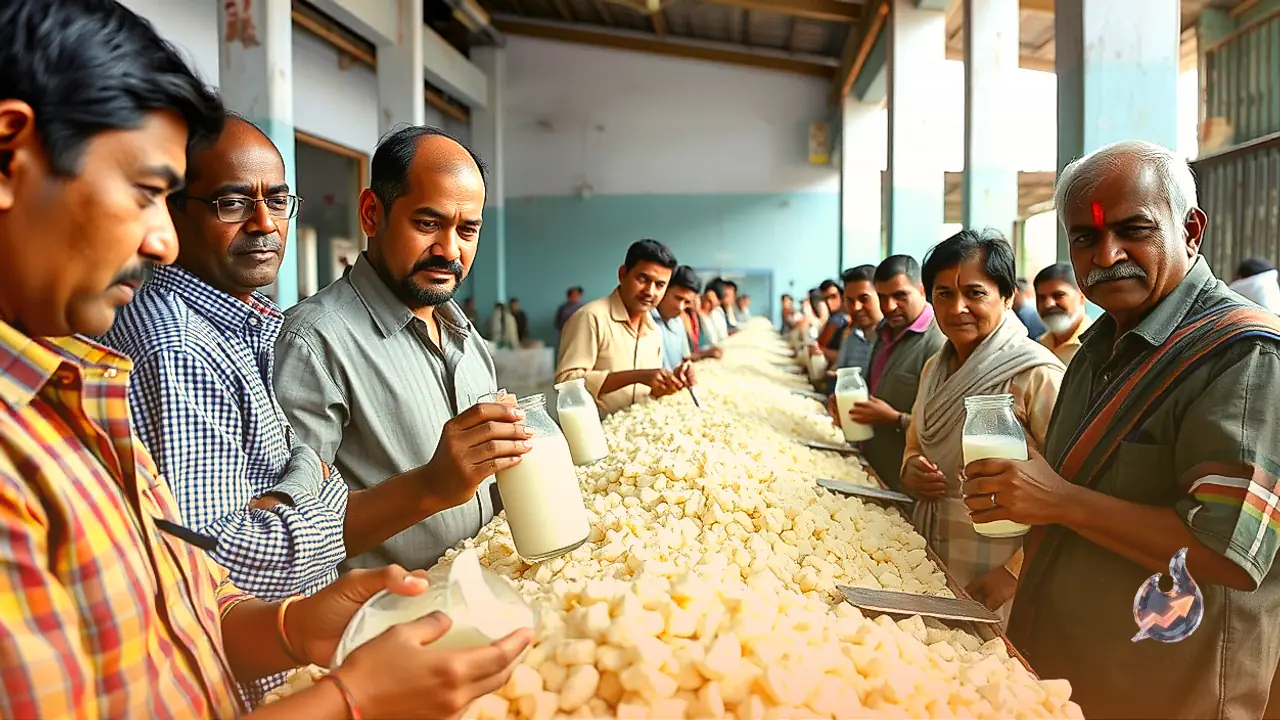

In the dairy and traditional sweet-making trade, the purity and fat content of raw milk serve as the ultimate benchmarks of quality. According to dairy professionals in Sitamarhi, one kilogram of pure, full-cream cow or buffalo milk typically yields between 200 and 250 grams of chenna. This output relies entirely on the natural cream and solid fat present in the milk. When milk is diluted with water or adulterated, the yield drops sharply to 150 to 200 grams, or even lower. Using toned or low-fat commercial milk produces only 150 to 180 grams of solids per kilogram. For this reason, commercial sweet makers consistently demand dense, untampered milk to ensure adequate production volume.
How Traders in Sitamarhi Spot Water Dilution
Shyam Kumar, a local trader engaged in the milk and chenna business, explains that he collects fresh milk directly from dairy farmers across rural villages. The collected milk is boiled, curdled into chenna, and then distributed across local markets. For milk vendors, securing a sufficient yield of curd cheese is essential to cover labor and operational expenses. If water has been introduced into the milk, the reduced solid output directly eats into trade margins. While long-standing relationships with rural livestock keepers foster trust, the actual weight of the strained chenna instantly reveals whether any excess water was added to the batch.
Planning Milk Requirements for Large Gatherings
Accurate estimates of milk and curd volume become critical during major community feasts, banquets, and wedding receptions where hundreds of guests must be served. For instance, catering for 500 guests with two pieces of sweets each requires a total of 1,000 pieces. Sweet makers calculate that preparing this quantity demands roughly 1.5 quintals, or 150 kilograms, of whole milk or chenna base. Professional confectioners rely on this exact ratio to place bulk dairy orders, preventing shortages while maintaining the desired texture and freshness throughout the event.
Step-by-Step Technique for Making Soft, Spongy Chenna
The texture and softness of homemade chenna depend heavily on proper curdling techniques rather than curdling agents alone. Begin by bringing the milk to a rolling boil, then remove it from the heat source and allow it to rest for 2 to 3 minutes. Never add acidic curdling agents to boiling hot milk; instead, mix lemon juice, vinegar, or citric acid with a small amount of water and stir it gently into the warm milk in small increments. Once the milk separates completely and the greenish whey clarifies, strain the mixture immediately through a clean muslin or cotton cloth. Rinse the collected solids thoroughly under cold running water to eliminate residual acidity. Finally, wrap the cloth into a bundle and press gently to expel excess liquid without drying out the curd.