




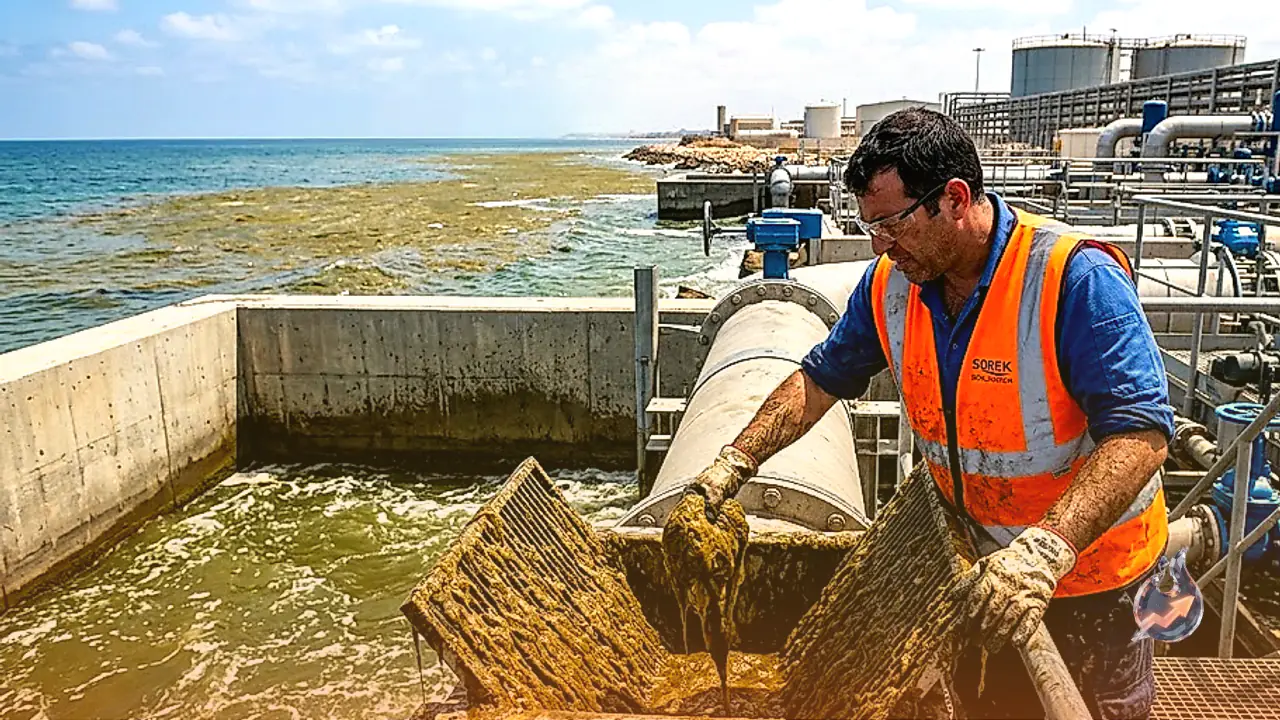

















A sudden and massive concentration of microalgae in the eastern Mediterranean Sea triggered a major disruption across Israel's marine drinking water infrastructure. Five out of the six critical coastal desalination plants responsible for transforming seawater into potable tap water suffered severe filter blockages. The sudden operational squeeze forced the national Water Authority to deploy road tankers to distribute drinking supplies across neighbourhoods in Jerusalem in late August. While the affected facilities have resumed processing, they remain restricted to operating at up to 50% capacity. Because the biological mass has lingered in open coastal waters for nearly three weeks, oceanographers and environmental engineers are raising alarms about the fragility of marine-reliant drinking supplies.
A 100-Kilometre Biological Blanket Chokes Coastal Intakes
At its peak development, satellite and marine assessments tracked the algae formation stretching across 100km in length and reaching up to 7km in width. The organic density proved thick enough to rapidly plug multi-stage filtration systems designed to screen incoming seawater. Mekorot, Israel's national water utility, described the event through spokesperson Lior Gutman as a huge carpet of microorganisms drifting directly across critical intake zones. Marine researchers trace the origin of the bloom to the Nile Delta, from where dominant northerly currents sweeping along the eastern Levantine coastline ferried the organisms northward along the beaches of Gaza and Israel.
This rapid multiplication was driven primarily by elevated Mediterranean sea-surface temperatures combined with continuous exposure to intense sunlight and an abundance of dissolved nutrients. Edo Bar-Zeev, a professor at Ben-Gurion University's Zuckerberg Institute for Water Research, characterized the scale and tenacity of the bloom as an unexpected mega event. Professor Bar-Zeev noted that in his approximately 20 years of taking ocean water samples, typical algae blooms normally dissipate within several days or at most a single week. In this instance, however, the thick organism layer remained anchored off the coast for an unprecedented duration.
Wartime Infrastructure Damage and Rising Nutrient Pollution
Environmental researchers point out that the ongoing war with Hamas and the resulting destruction of municipal wastewater facilities inside Gaza have likely worsened the underlying marine conditions. Gidon Bromberg of the cross-border environmental organisation EcoPeace Middle East explained that sewage carries concentrated biological nutrients that fuel explosive algae growth whenever marine temperatures spike.
Bromberg observed that even before the outbreak of active hostilities, municipal wastewater processing across Gaza suffered from severe technical obsolescence due to Israeli border restrictions. Constructing and maintaining modern effluent treatment facilities requires specialized supplies, such as bulk cement, which Israeli defense authorities categorized as dual-use goods capable of being repurposed by Hamas for military applications. As a direct consequence of extensive bombardment crippling local infrastructure, approximately 40,000 cubic metres of raw, untreated sewage currently discharges into the sea every single day from Gaza, adding substantial nutrient loads to the surrounding coastal ecosystem.
Domestic Resilience Masked Growing Regional Disparities
Together, the six affected facilities supply more than 60% of the potable water consumed inside Israel. Despite the extensive technical disruption, ordinary domestic life remained largely insulated from the outage. Mekorot's Lior Gutman stated that agricultural users relying on recycled irrigation lines experienced virtually no operational deficits, while 99% of Israeli households maintained uninterrupted domestic service without noticing the emergency measures.
This domestic stability contrasts sharply with living conditions across Gaza. An assessment published by the humanitarian medical group Doctors Without Borders revealed that Israeli bombardments have decimated roughly 90% of the water and sanitation infrastructure across the Gaza Strip, forcing civilian populations to endure severe daily struggles simply to secure basic survival rations of clean water.
Global Repercussions for Coastal Desalination Reliance
Confronted with recurring droughts and expanding demographic demand, Israel developed into a premier international pioneer in reverse osmosis desalination, with commercial engineering firms designing and exporting treatment technology globally. However, the sudden operational paralysis inflicted by a single marine biological event has challenged assumptions regarding the absolute reliability of open-sea intakes. Gidon Bromberg emphasized that this unprecedented operational freeze serves as an urgent wake-up call for the entire global water sector, particularly across the arid Middle East where desalination plants serve as the central pillar of national water security planning.