






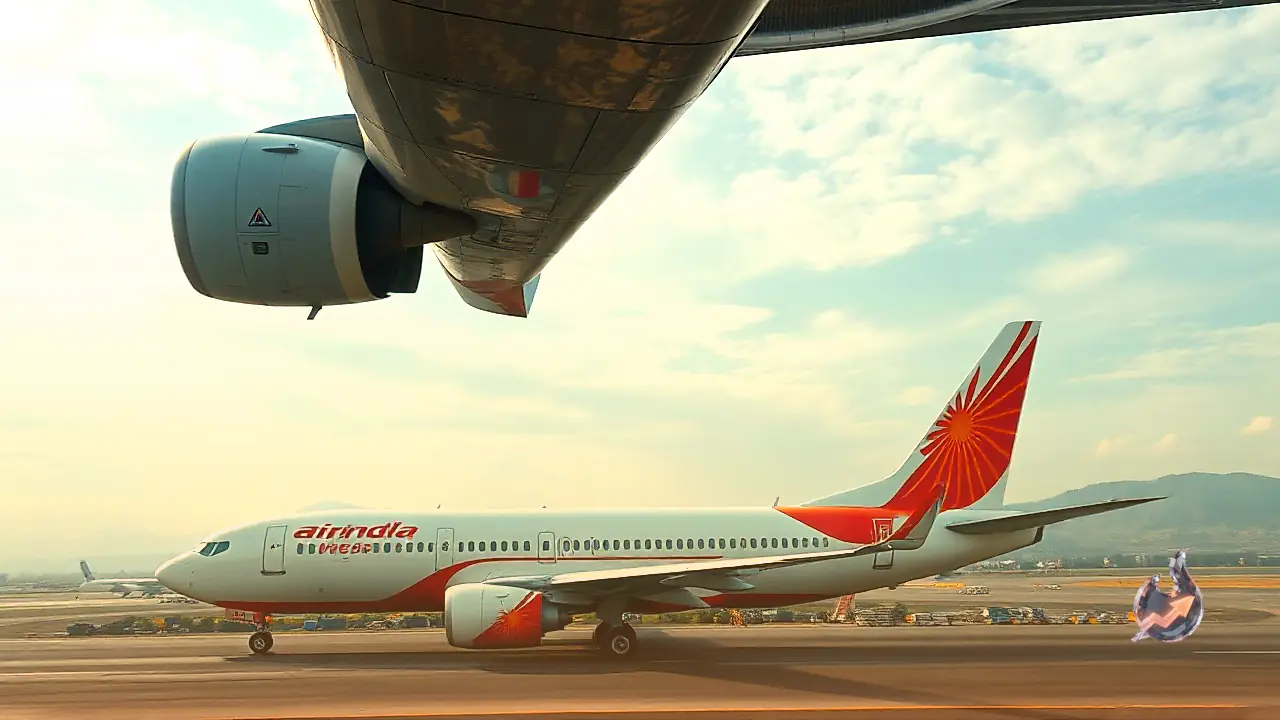















An initial technical evaluation conducted by aircraft manufacturer Airbus has shed light on the severe turbulence incident involving Air India flight AI2379, traveling from Phuket to Delhi on August 4. According to the findings, the aircraft experienced a sequence of hydraulic failures during a sudden 300-foot drop in altitude. This chain reaction temporarily disrupted control over the flight control surfaces and led to the disconnection of the autopilot system. The incident recorded a sharp pitch variation, prompting emergency physical inputs from the First Officer in the cockpit to regain stability.
Hydraulics Failure and 4-Second Flight Control Disruption
Details released in a technical dossier dated August 10 by Airbus Customer Services reveal that the event involved an Airbus A320 aircraft bearing serial number MSN 08470. Airbus derived its preliminary timeline after decoding data retrieved from the aircraft's Digital Flight Data Recorder (DFDR). The document officially catalogues the incident under the title 'Sudden Loss of A/C Altitude of 300 Feet, Then Recovered'. The recordings show that the technical cascade initiated at approximately 04:02:44 when a fault was registered in the Green Hydraulic (G HYD) system.
Just one second later, at 04:02:45, both the Blue and Yellow hydraulic systems became compromised. The simultaneous degradation of all three hydraulic circuits caused a transient loss of control authority over the elevator and aileron control surfaces on both sides of the aircraft for approximately four seconds. During this window, the Right Elevator moved to approximately +0.6 degrees while the Left Elevator shifted to around -1.0 degree. Concurrently, the ailerons transitioned into damping mode, resulting in deflection that drove an increase in the aircraft's pitch.
Autopilot Disconnection and First Officer Intervention
Amid the growing flight control instability, Autopilot 2 (AP2) automatically disconnected at 04:02:46. Upon autopilot disengagement, the First Officer executed a full nose-down control input to arrest the pitch surge and stabilize the aircraft. Within five seconds, the hydraulic systems began recovering pressure. At 04:02:51, the Blue hydraulic system restored operational functionality, followed closely by the Yellow and Green hydraulic circuits. As hydraulic pressure normalized, the flight control surfaces resumed standard deflection responses, allowing the crew to maintain steady flight.
Mandatory Technical Inspections Ordered by Airbus
In response to the preliminary findings, Airbus has instructed Air India to perform comprehensive operational testing across all three hydraulic networks (Green, Blue, and Yellow). The directive requires meticulous verification of all associated pressure switches, pressure transducers, and leak measurement switches. Furthermore, Airbus has requested complete maintenance logs for the aircraft's hydraulic systems covering the 30 days leading up to the incident to identify any pre-existing maintenance anomalies or recurring component faults.
Structural Integrity Checks and AFS Diagnostics
Beyond hydraulic components, Airbus recommended rigorous ground scanning and diagnostic testing of the Automatic Flight System (AFS). The manufacturer has asked for detailed parameters from the Flight Guidance and Flight Control Computers, as well as operational data from the Flight Augmentation Computer (FAC). Because the rapid 300-foot descent induced significant load exceedances on the airframe, Airbus emphasized that a detailed evaluation of the aircraft's structural integrity is mandatory alongside mechanical system checks. Detailed pilot reports explaining the visual observations and cockpit conditions during the event have also been requested.
Human Factors and Preliminary Status of Findings
The broader investigation into the flight has also encountered human factor elements, including findings indicating that the pilot had consumed cannabis. However, Airbus clarified that its technical dossier represents an initial engineering assessment rather than a final cause determination. Given the multi-faceted nature of the event, complete analysis of both the airframe's structural integrity and onboard electronic systems remains ongoing, and further technical directives may be issued as additional data is evaluated.