




















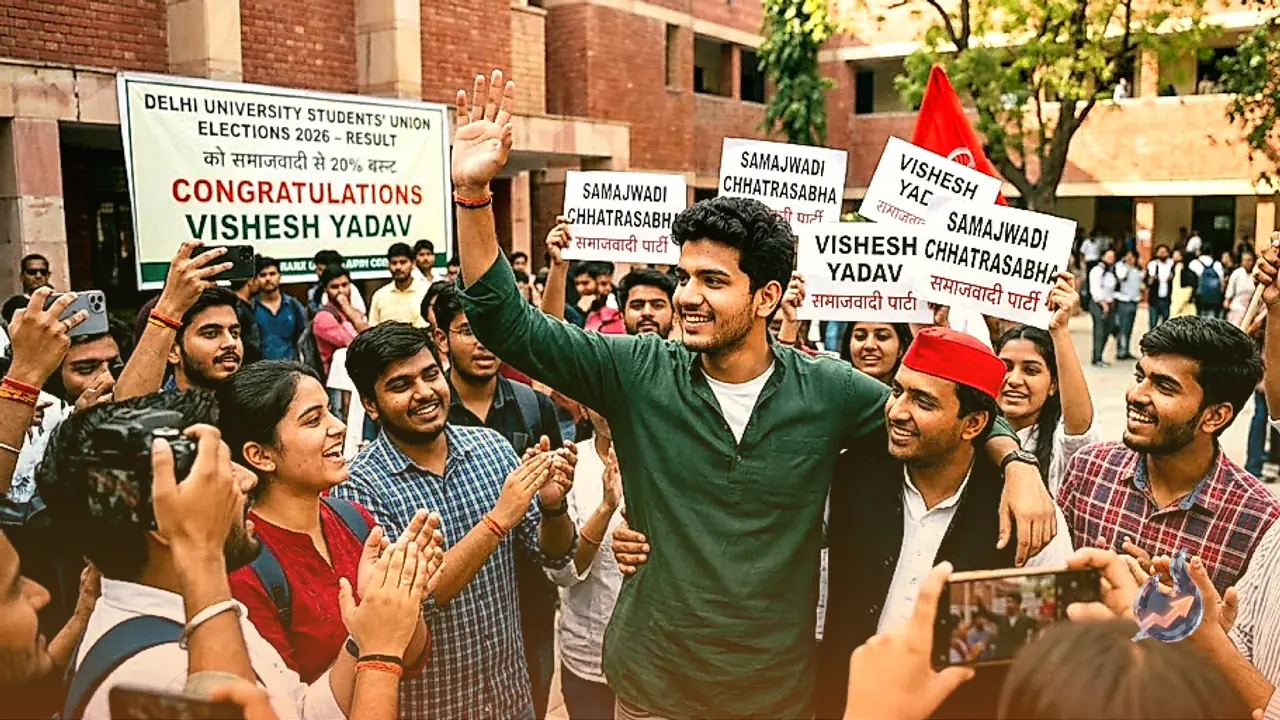

The outcome of the Delhi University Students Union (DUSU) elections 2026 has triggered intense political ripples well beyond the national capital, sending clear signals down to the power corridors of Uttar Pradesh. The most talked-about figure emerging from the central panel contest is Vishesh Yadav. After being denied a nomination for the joint secretary position by Congress's student wing NSUI, Yadav found fresh political momentum upon meeting Samajwadi Party national president Akhilesh Yadav. Backing the youngster, the SP chief fielded him under the Samajwadi Chhatrasabha banner, turning the joint secretary race into a fiercely watched multi-cornered contest.
While the Akhil Bharatiya Vidyarthi Parishad secured victories on three key central panel seats comprising president, secretary, and joint secretary, with an independent candidate clinching the remaining slot, the joint secretary contest delivered nail-biting suspense. Early counting trends saw Vishesh Yadav surprise observers by sustaining a comfortable lead of over 5,413 votes through the sixth round. In the final tally, ABVP nominee Lakshya Raj Singh won the seat with 16,615 votes, but Yadav finished a strong second by polling 15,778 votes. He pushed the NSUI candidate down to third place, who managed 15,206 votes. Securing nearly 16,000 votes in an expansive university campus marks an unprecedented performance for the regional outfit's student wing.
Sustained Early Advantage and a Strong 15,778 Vote Count
Polling close to 16,000 votes in a major national university reflects the personal appeal of Akhilesh Yadav and his party's organizational mobilization. Soon after the declaration of the results, social media platforms buzzed with commentary drawing parallels to the 2027 Uttar Pradesh assembly elections. Online observers pointed out that those who considered Akhilesh Yadav and his party restricted solely within the geographic borders of Uttar Pradesh must take note of this electoral footprint in Delhi.
Strategic Implications for the 2027 Uttar Pradesh Assembly Battle
Political analysts view this development as a notable indicator for the upcoming 2027 state elections in Uttar Pradesh. Outperforming the Congress-affiliated student wing to secure the runner-up position highlights Akhilesh Yadav's persistent resonance among young voters. By finishing ahead of Congress in a premier university campus, the Samajwadi Party has reinforced its credentials as the pre-eminent opposition force challenging the ruling establishment in UP.
Gen Z Alignment and Mobilization of Eastern UP Students
An examination of the DUSU 2026 voting pattern suggests that youth from Uttar Pradesh and particularly the Purvanchal belt studying in Delhi are rallying behind the leadership of Akhilesh Yadav. The political tactic of adopting and backing young leaders overlooked by other parties to provide them with high-profile platforms is widely anticipated to remain a key weapon in the Samajwadi Party's 2027 electoral playbook.
Sharpening the Youth Machinery for the Next State Elections
Galvanized by the unexpected surge in Delhi University, the Samajwadi Party has begun fine-tuning its student and youth wings across grassroots networks in preparation for the 2027 state contest. Akhilesh Yadav's calculated intervention demonstrated that strategic guidance and organizational backing can elevate an underdog contender directly into prime contention.
Even though ABVP retained the joint secretary post, the electoral impact generated by Vishesh Yadav sent an unmistakable signal from Delhi to Lucknow regarding youth consolidation under the Samajwadi Party flag. The central question now confronting political observers is how the Gen Z demographic will reshape the Uttar Pradesh 2027 electoral landscape and how the BJP intends to counter this emerging youth alignment, as the student union results point toward a direct bilateral face-off between the BJP and the Samajwadi Party.