













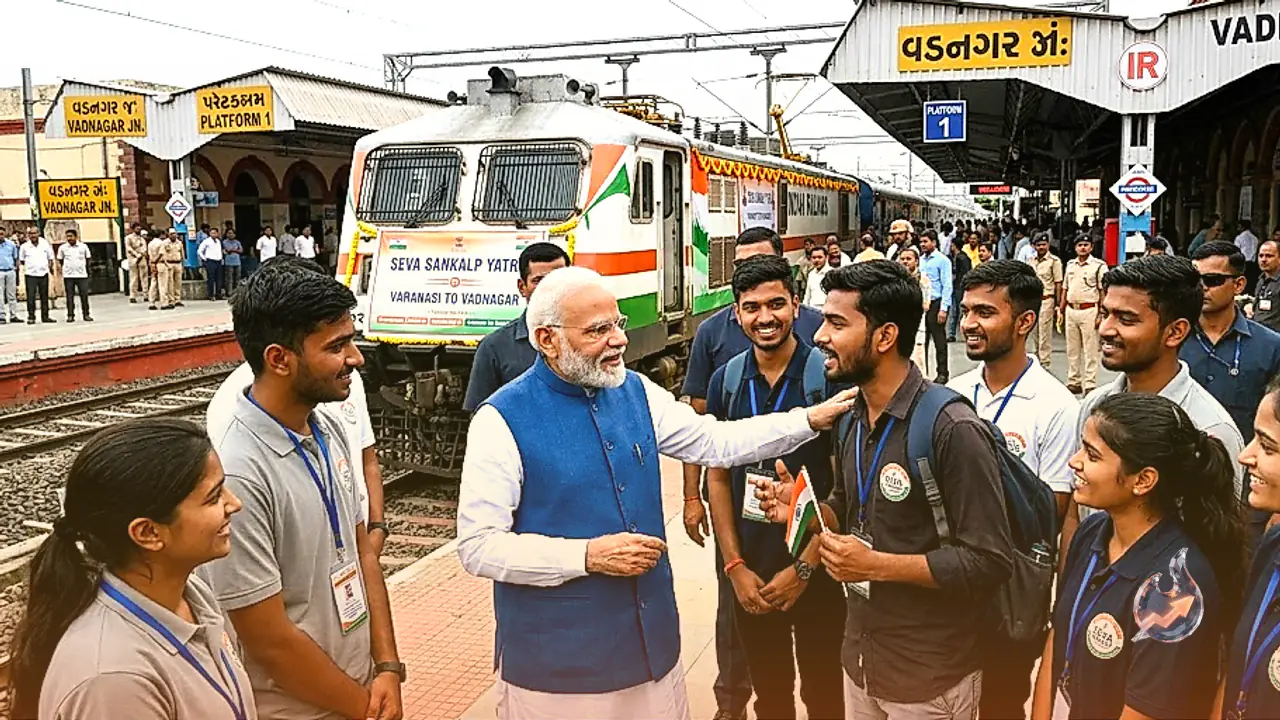

Prime Minister Narendra Modi on Friday connected via video conferencing with a group of young participants embarking on a journey from Varanasi to Vadnagar under the Seva Sankalp campaign. Throughout the interaction, he addressed the vital role of selfless public service, continuous social reform, and the necessity of keeping community development free from narrow electoral calculations. The Prime Minister underscored that positive societal change must remain an enduring priority rather than an instrument for vote-bank politics, stressing that genuine service rendered to humanity deserves unreserved respect and dignity.
Drawing upon the legacy of Mahatma Gandhi, Prime Minister Modi observed that an objective look at Gandhi's life reveals he was not merely leading the national freedom struggle against British colonial rule, but was fundamentally an exceptional social reformer. Gandhi consistently challenged deeply entrenched social evils and worked towards eliminating regressive practices. Emphasising this heritage, Modi called upon young citizens to dedicate their energies toward continuous reform, ensuring that those who silently serve the community receive the public honour they rightfully earn.
The Intent Behind Washing the Feet of Kumbh Sanitation Staff
During the interaction, the Prime Minister reflected on his widely noted gesture of washing the feet of sanitation staff during the Prayagraj Kumbh. He recounted that the tireless dedication of the cleaning workforce had earned the Kumbh international acclaim for cleanliness, elevating India's standing on the global stage.
Modi noted that his deliberate choice arose from a heartfelt conviction that individuals who had brought such immense dignity to the country deserved the highest mark of reverence. By washing their feet and seeking their blessings, he aimed to formally honour their hard work and establish that sanitation workers represent the frontline of national pride and hygiene. He remarked that respecting the labour of essential workers remains foundational to an egalitarian and conscious society.
Bridging the Urban-Rural Divide Over Twelve Years
Speaking on broader developmental strides, Prime Minister Narendra Modi highlighted that the disparity between urban and rural India has narrowed significantly over the past 12 years. Upgraded infrastructure in the countryside has substantially reshaped daily living standards and created newer economic pathways.
The Prime Minister stated that rural regions have witnessed marked progress in civic amenities and basic infrastructure, while empowerment initiatives have noticeably bolstered self-reliance among women and young girls. He pointed out that this structural uplift forms the backbone of balanced and inclusive growth across the nation.
Vadnagar's Upbringing and Kashi's Ethos of Service
Reflecting on the formative chapters of his own life, Prime Minister Modi remarked that his native Vadnagar endowed him with enduring personal values and foundational lessons, while Varanasi infused those values with diverse dimensions of public service. Expressing satisfaction with the youth initiative, he observed that the participants were infusing their expedition with the vibrant spirit of selfless dedication.
He described these qualities as the colours of patriotism, service, moral culture, and resolute determination, all oriented towards realising the vision of a developed India. Modi noted that the Seva Sankalp Yatra visibly exemplifies these aspirations at every stage of its progression.
Recalling Pandit Deendayal Upadhyay's Seven Principles
Noting that the day marked the birth anniversary of Pandit Deendayal Upadhyay, Prime Minister Modi invoked the thinker's lifelong commitment to continuous movement, reflected in the Vedic aphorism 'Charaiveti, Charaiveti, Charaiveti'. He characterised Deendayal Upadhyay as a ceaseless traveller whose dedication to societal duty remains a guiding inspiration for public workers committed to the path of national welfare.
Modi highlighted seven operational principles outlined by Pandit Deendayal Upadhyay to guide individuals in fulfilling their social responsibilities, noting that their remembrance revitalises party cadres and volunteers alike
- Spirit of Service (Seva Bhav): Unconditional dedication to uplifting fellow citizens.
- Balance (Santulan): Equilibrium across thoughts, actions, and social responsibilities.
- Restraint (Sanyam): Disciplined conduct in personal and public engagements.
- Coordination (Samanvayak): Harmonising diverse sections of society collaboratively.
- Positivity (Sakaratmakta): Maintaining an optimistic and constructive mindset in all circumstances.
- Compassion (Samvedna): Deep sensitivity towards the struggles and hardships of others.
- Dialogue (Samvad): Continuous, honest communication to build trust and mutual understanding.
Parallel Journeys Linking Kashi and Vadnagar
Prime Minister Modi pointed out a notable continuity in the campaign, mentioning that on the preceding day, he had interacted with another group travelling in the reverse direction, from Vadnagar to Varanasi. He expressed personal satisfaction in connecting with participants who originated from his birthplace on one day, and those travelling from his parliamentary constituency to his home town on the next.
He commended the travelling cohort for seeking the blessings of Baba Vishwanath and the sacred Ganga before setting out toward the historic Hatkeshwar Mahadev temple in Vadnagar. Modi noted that undertaking civic service activities continuously along the travel route makes the youth initiative exceptionally meaningful and inspiring for communities across the path.