




















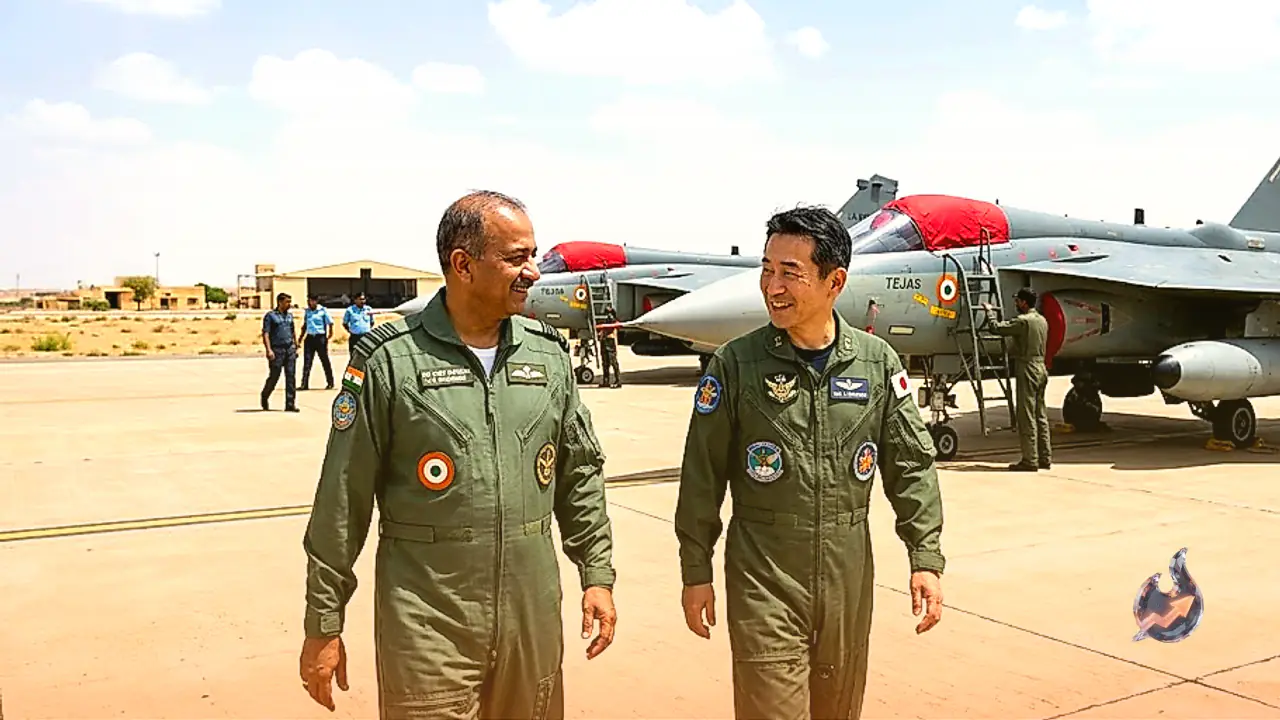

A remarkable display of expanding defense alignment unfolded over Jodhpur Air Force Station as the military chiefs of India and Japan took to the skies in domestically produced Tejas fighter jets. Undertaken on the twelfth day of the bilateral exercise Veer Guardian 2026, the mission featured Indian Air Force Chief Air Chief Marshal AP Singh and Japan Air and Self-Defense Force Chief of Staff General Morita Takehiro. The joint aerial flight offered a clear demonstration of increasing interoperability and strategic harmony between the two partner nations in Rajasthan.
Tactical Formation Flight and Flight Deck Experience
Air Chief Marshal AP Singh piloted his aircraft solo, leading the tactical Tejas formation right from the takeoff phase. Flying alongside as a wingman, Japanese Air Chief General Morita Takehiro was seated in a twin-seat Tejas variant alongside co-pilot Group Captain I Samrat. Once airborne, both combat aircraft executed precise maneuvers in a synchronized formation flypast over the airfield. The mission provided the visiting Japanese commander a firsthand perspective on the indigenous fighter's flight dynamics, digital avionics suite, and operational agility. Prior to touchdown, the two jets smoothly peeled away into individual landing patterns to conclude the sortie safely.
Deployments at Jodhpur for Veer Guardian 2026
The bilateral military drill commenced on September 9 and is scheduled to wrap up on September 22. Japan dispatched its personnel and equipment via C-2 transport planes, deploying frontline F-2 strike fighters from Tsuiki Air Base into the Rajasthan desert. Countering with comprehensive aerial assets, the Indian Air Force fielded a formidable fleet comprising Rafale, Sukhoi-30MKI, and the indigenous Tejas. Combat pilots and mission controllers across both air wings have been immersed in sophisticated simulated dogfights, tactical intercepts, and daily logistical coordination across the multi-week timeline.
Resolving Past Delays Through Operational Engagement
Reflecting on past interactions while addressing the media, Air Chief Marshal AP Singh recalled the Tarang Shakti 2024 exercise. During that timeframe, when he was serving as the Vice Chief of Air Staff, he had interacted with the Japanese military delegation. However, persistent adverse weather in Southeast Asia had prevented Japanese combat jets from reaching Indian territory, leaving planned joint sorties unfulfilled. The Air Chief pointed out that this current iteration successfully bridged that gap. He underscored that collaborative operational deployments serve as vital learning environments where aviators assess standard operating procedures and bolster collective preparedness.