




















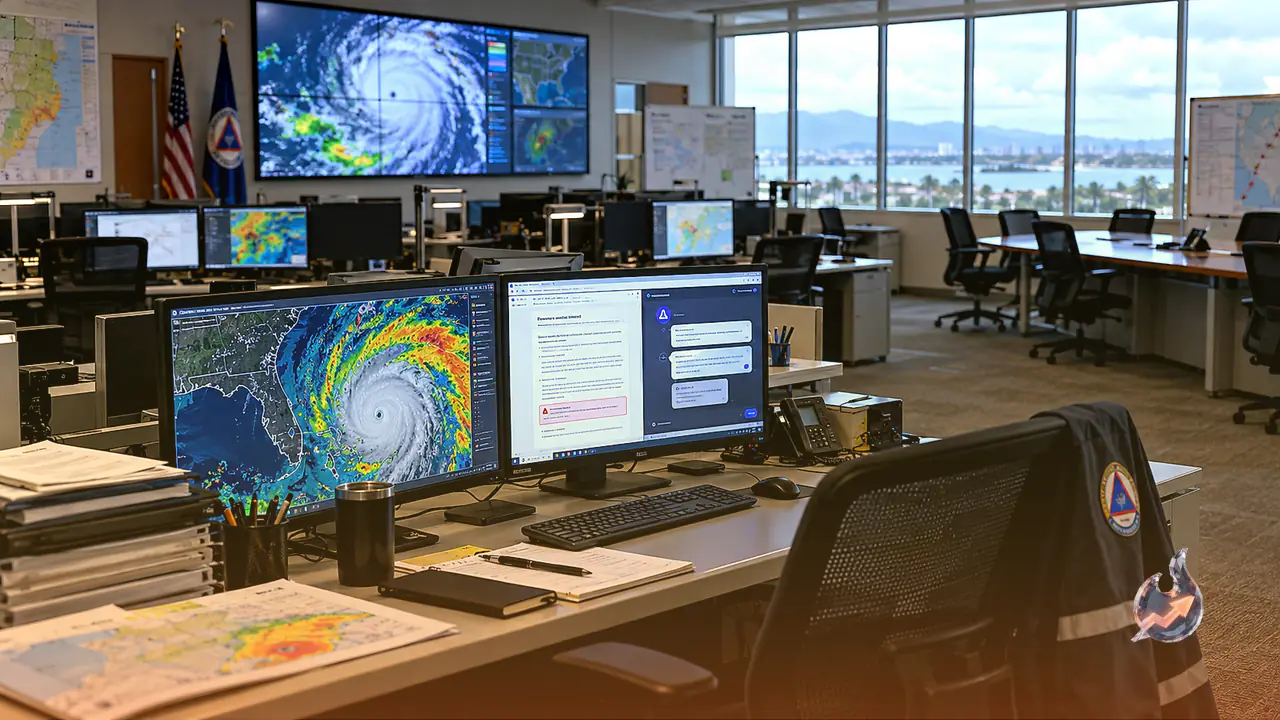

When extreme weather barrels toward coastal communities, the precision of a public warning can decide whether residents escape or perish. The delicate nature of crisis messaging became vividly clear recently after Hurricane Isaias roared ashore along the Gulf Coast as a Category 3 tempest. Following the landfall, Laura Myers, director of the University of Alabama’s Center for Advanced Public Safety, answered a call from an Alabama meteorologist with troubling news. A county disaster coordinator had circulated a graphic forecasting a ferocious sting jet of hurricane-force gusts threatening the Alabama coastline. Upon closer inspection, the alarming visual was not created through verified scientific modeling; the official had generated the illustration using an artificial intelligence chatbot. While the manager merely hoped to jolt local residents into taking the impending storm seriously, the resulting visual presented a meteorologically inaccurate picture of atmospheric conditions.
The Strains of Human Communication in Disaster Operations
Formal policies across emergency bureaus rarely authorize staff to deploy generative automated platforms. Even so, specialists throughout the disaster response community acknowledge that unauthorized utilization of these digital assistants is already deeply entrenched across municipal and state departments. Hundreds of technology enterprises are actively marketing algorithmic platforms to public safety administrators, pitching systems to evaluate flood destruction or synchronize logistical operations. Among all these offerings, community warning tools have ignited the strongest appetite among state workers and commercial vendors. The reason for this growing demand is straightforward: emergency directors frequently struggle to formulate crisp, swift bulletins during unfolding crises. That shortcoming does not reflect poor dedication, but rather natural human tendencies. Under intense pressure, managers often default to bureaucratic jargon unfamiliar to laypersons, overlook basic geographic markers assuming people already know them, or clutter alerts with peripheral details that obscure urgent protective actions.
Jeannette Sutton, a veteran disaster communication researcher based at the University of Albany who designed an alert template framework, notes that public safety bureaus operate under severe personnel and financial shortages. She explains that overworked local teams often juggle multiple responsibilities simultaneously, striving to prevent operational blunders while lacking the luxury to refine communication methods. At local and regional levels, these municipal specialists form the frontline shield during catastrophic weather occurrences, well before federal disaster officials arrive on site. Because community trust serves as their foundational capital, the exact phrasing delivered during crisis hours can either preserve or obliterate that vital confidence.
Historical Lessons in Communication Failures
Recent decades provide ample evidence of how ambiguous or clashing human guidance can paralyze an emergency response. In 2016, neighboring municipalities in California created widespread disorientation by issuing conflicting voluntary and mandatory evacuation declarations for the exact same advancing wildfire. Similarly, during the destructive 2019 Australian bushfire crisis, authorities distributed alerts instructing citizens to watch and act. Government reviews later acknowledged that this unfamiliar phrasing triggered immense bewilderment because citizens had no concept of what tangible actions were expected of them.
Flawed communication can yield lethal outcomes. Following the 2017 Thomas Fire in Montecito, California, torrential downpours triggered catastrophic mudflows across scarred hillsides. Regional leaders in Santa Barbara County faced immense hurdles communicating the impending debris threat to a public already exhausted by weeks of evacuation stress, an apathy researchers classify as warning fatigue. Officials delivered notices to residents inside voluntary evacuation zones advising them to monitor changing skies and stay prepared to abandon their properties. In reality, immediate departure was essential, yet many residents viewed the guidance as optional, while others refused to vacate their residences for a second time within a single month. The resulting slide destroyed neighborhoods, killing 23 individuals and injuring over 160. As research confirms, distributing muddled directives deprives public agencies of their fundamental role as dependable guardians of civic safety.
Algorithmic Speed Versus Human Hesitation
From an operational standpoint, algorithmic language tools present an enticing solution for streamlining emergency messaging. While federal agencies provide rigorous instructional programs on communication protocols, human directors often struggle to recall distant classroom guidelines amid operational chaos. Modern computational models differ fundamentally; they can ingest hundreds of thousands of historical advisories within minutes, assimilate academic principles of crisis messaging, and polish a flawed draft in seconds. Rob Dale, an emergency management head and former meteorologist in Ingham County, Michigan, points out that when an unexpected chemical hazard threatens a community and phone banks are ringing continuously, a computational system can produce a superior initial message much faster than an overwhelmed official whose last formal alert was written years prior.
Dale has experimented with computer models to draft hypothetical alerts for internal drills, though he has not broadcasted an automated bulletin during an active incident. Situated in central Michigan, Ingham County rarely encounters severe threats like coastal hurricanes or massive forest fires. Nevertheless, Dale indicates that should a sudden crisis emerge, he would comfortably allow an automated system to compose the preliminary advisory text, provided he retains exclusive authority over final distribution. Several industry developers maintain the software is already qualified for public service. EM1, a developer creating specialized machine learning software for emergency managers, utilized Sutton’s research to configure an internal platform that executives claim outmatches human practitioners. In simulated tests covering tsunamis and forest fires, the startup claims its software consistently matches or eclipses human benchmarks.
The San Juan River Evacuation Experiment
A striking demonstration of this technological capability occurred when researchers examined an authentic flood notification issued by a New Mexico municipality along the San Juan River. The real-world bulletin read: “Breeched banks. The water is rising. EVACUATE NOW. McGee Park open for people and pets, RV.” When the EM1 model evaluated the text, it instantly reorganized the fragmented advisory into a coherent directive. The upgraded version read: “San Juan County: Floodwater is rising near [location]. People in [evacuation area]: LEAVE NOW for higher ground. Do not walk or drive through floodwater. McGee Park is open for people and pets. Check [official update source] for updates.” In doing so, the software corrected an obvious spelling error, identified the issuing authority, specified actionable survival steps like avoiding flooded roadways, and designated where citizens should monitor verified follow-up reports.
While EM1 maintains commercial agreements with roughly one hundred educational districts and civic bodies, none currently utilize the software to autonomously publish severe weather alerts. Participating agencies confine their usage to preparatory drills, policy development, and internal workflow tests. Nevertheless, researchers confirm that municipal staff routinely use consumer chatbots to draft official statements without public acknowledgement. Sutton observes that professionals attending her workshops frequently present polished notification drafts generated within seconds via ChatGPT or Gemini. Sarah Miller, an emergency management professor at Florida’s Pierce College and instructor with the National Disaster Preparedness Training Center, confirms that informal deployment on personal or free accounts is widespread among municipal workers.
Public Skepticism and the Perils of Over-Automation
Despite obvious advantages in processing speed, moving to automated disaster communications introduces significant hazards. Individuals who harbor doubts regarding computational technology or who mistrust administrative authorities may reject machine-written advisories outright. Discontent of this nature surfaced in Syracuse, New York, where a municipal labor union launched litigation against city hall after officials automated responses for non-emergency dispatch lines.
Ginny Katz, creator of the crisis technology advisory firm HazAdapt, emphasizes that citizens depend on messages that convey genuine human empathy and authentic concern, traits typically absent in synthetic phrasing. Furthermore, the capacity to generate messages effortlessly risks flooding the public with excessive bulletins, accelerating the onset of citizen warning fatigue. As with other emerging automated tools, safety specialists note that the software remains dependent on human oversight. A veteran administrator can harness automated assistance to accelerate life-saving advisories, whereas an untrained worker confronting a crisis might fail to detect algorithmic fabrications produced by tools like ChatGPT or Claude. Justin Snair, founder of emergency software firm Preppr, observes that public willingness to trust an advisory depends entirely on individual attitudes toward machine-generated communications versus human instructions. Until comprehensive guardrails are established, human scrutiny remains indispensable.