





















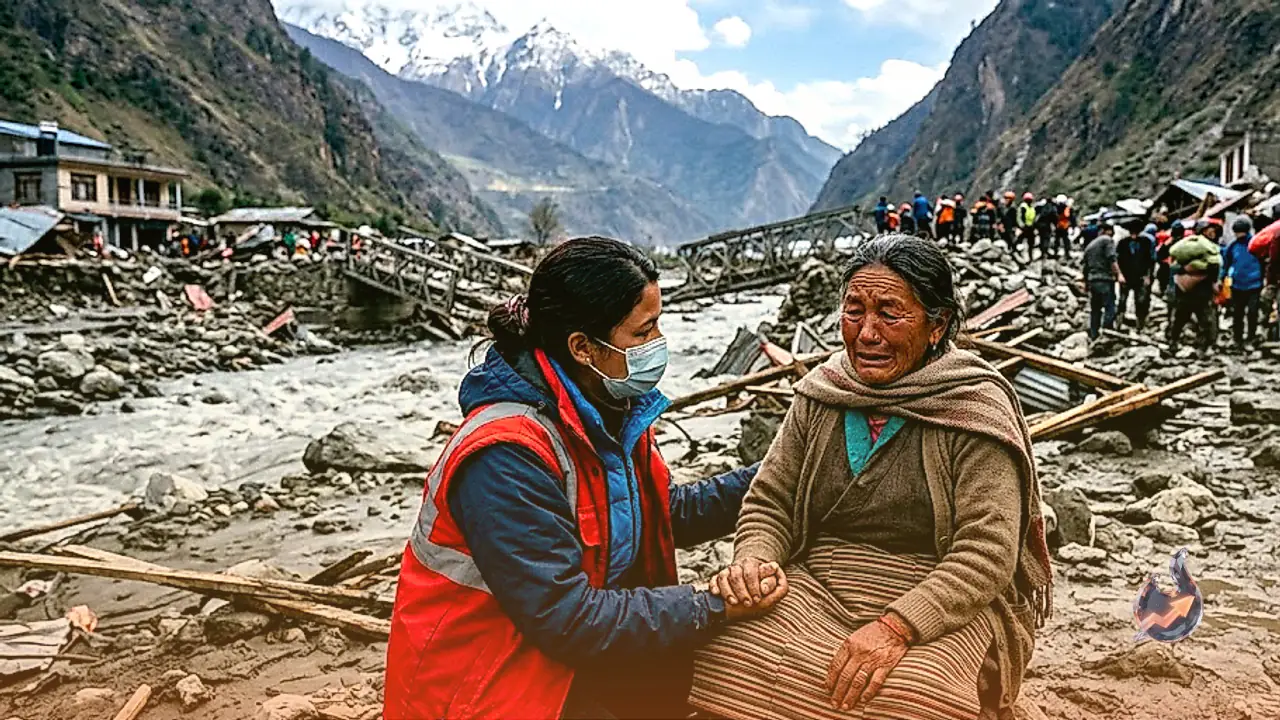

A catastrophic flash flood swept through the rugged border region separating Nepal and Tibet on Wednesday, resulting in at least 160 fatalities and leaving hundreds of individuals unaccounted for, including numerous foreign tourists. Dramatic video clips circulating on social platforms show panicked residents fleeing a surge of water that demolished buildings and swept away motor vehicles in its path. Preliminary evaluations of satellite data alongside official statements from the Nepalese government indicate that the deluge originated when a massive chunk of a high-altitude glacier detached, plunging hundreds of feet and initiating a destructive landslide down the mountain valley.
Cascading Glacial Hazards and High-Altitude Risks
Environmental scientists emphasize that escalating global temperatures are rendering ice formations across the Himalayan range increasingly unstable, heightening the threat of sudden disasters. Joseph Shea, an associate professor of geography at the University of Northern British Columbia, noted that glaciers in the affected zone are experiencing undeniable retreat. Although substantial glacial mass remains at elevated altitudes, observational data confirms persistent thinning and spatial reduction across the region.
Global statistics indicate that the planet's glaciers have surrendered 5 percent of their total ice volume since 2000, with localized impacts proving even more severe. Between 1970 and 2010, Nepal lost nearly a quarter of its glacial surface area, leading to the complete disappearance of more than 160 smaller glaciers. Recent scientific models project that up to 40 percent of global glacial ice mass could permanently vanish if average temperature increases exceed 1.5 degrees Celsius above pre-industrial levels.
Landslides and Outburst Floods Threaten Millions
The reduction of glacial volume triggers complex cascading environmental hazards. Shea explained that as glaciers shrink, they forfeit their capacity to anchor loose sediment, frequently precipitating destabilizing landslides. Furthermore, retreating ice leaves behind large, impounded lakes at extreme elevations. If a sudden landslide impacts one of these high-altitude bodies of water, the resulting wave can breach natural retaining dams, triggering a catastrophic collapse known as a glacial lake outburst flood. Two such events affected Nepal last year alone, exposing vulnerable populations to severe ongoing risks.
Force of the Fall and Seismic Signals
Investigative findings suggest that Wednesday's disaster was generated by a direct collapse of ice into the valley catchment below. Daniel Shugar, a geologist based at the University of Calgary in Canada, reported that satellite imagery suggests a 2,000-foot-wide section of glacial ice broke away and fell roughly 4,000 feet. The intense kinetic force of this sheer descent pulverized the frozen structure directly into high-velocity water. Shugar noted that while definitive conclusions require further study, elevated ambient temperatures earlier in the week likely accelerated snowmelt on the glacier surface prior to the structural failure.
Instruments operated by the US Geological Survey registered the physical force of the ice collapse and subsequent debris flow as a magnitude 5.2 seismic event. Similar thermal destabilizations have yielded lethal outcomes elsewhere in recent years. A major glacial collapse in Switzerland last year buried an entire township, while an ice breach in Italy killed 11 mountaineers in 2022. During summer months, warming atmospheric conditions thaw alpine permafrost, freeing massive rock and ice structures that were previously frozen solid into dangerous movement.