





















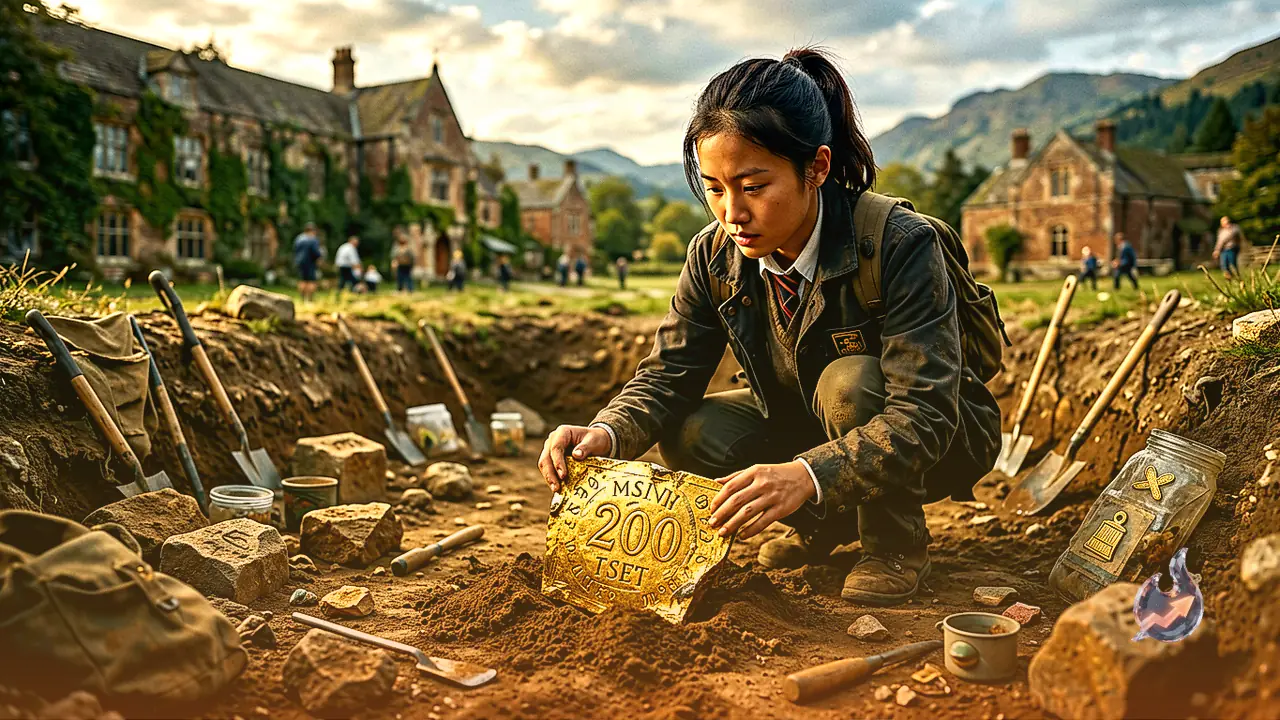

During an archaeological excavation in the Redesdale valley of Northumberland in northern England, a university student made a remarkable historical discovery. Yara Souza, an American student hailing from Florida who attends Newcastle University, uncovered a precious gold artifact estimated to be around 1200 years old. What makes the find even more extraordinary is that it occurred just ninety minutes into her very first experience on an excavation site. As the team carefully peeled back layers of soil, a subtle glitter caught her attention, leading to a discovery that has excited historians and researchers alike.
Intricate Carvings of the Ninth Century Gold Artifact
The unearthed item measures approximately 1.5 inches in length and features extraordinarily detailed craftsmanship. Despite its small physical size, the object displays intricate artistic carving, culminating in a decorative finial at one of its ends. Archaeological experts evaluating the piece believe it originates from the ninth century. During that historical era, gold was an exceptionally rare commodity unattainable by ordinary members of society, remaining exclusively within the reach of high ranking individuals and elite classes. Consequently, researchers hypothesize that this golden object was not an everyday ornament, but rather held significant ceremonial value or belonged to a religious ritual.
Historical Importance of the Redesdale Valley Site
The location of the excavation adds another compelling dimension to the find. The site sits in close proximity to Dere Street, a prominent ancient Roman road that historically functioned as a vital travel route connecting York to Scotland. Even after the collapse of the Roman Empire, Dere Street retained its strategic and commercial significance across centuries. Furthermore, the region was situated near influential medieval religious centers such as Jedburgh and Hexham. Historians suggest that a prominent traveler, noble, or high ranking religious official traveling along this thoroughfare may have accidentally lost the precious item or deliberately buried it in the earth during their journey.
Turning Point for Student and Future Museum Display
For Yara Souza, discovering such an important relic felt completely surreal. She revealed that she had never imagined coming across a major historical find so early in her first excavation project. The previous year, illness had prevented her from taking part in an archaeological dig at a Roman fort. However, this initial setback ultimately paved the way for an even greater historic moment in the Redesdale valley. Interestingly, this is not an isolated event in the area. In the year 2021, a metal detectorist searching the same region stumbled upon a remarkably similar golden object. Both of these historic artifacts will now undergo in depth scientific analysis to determine their precise origins before being placed on public display for visitors at the Great North Museum.