























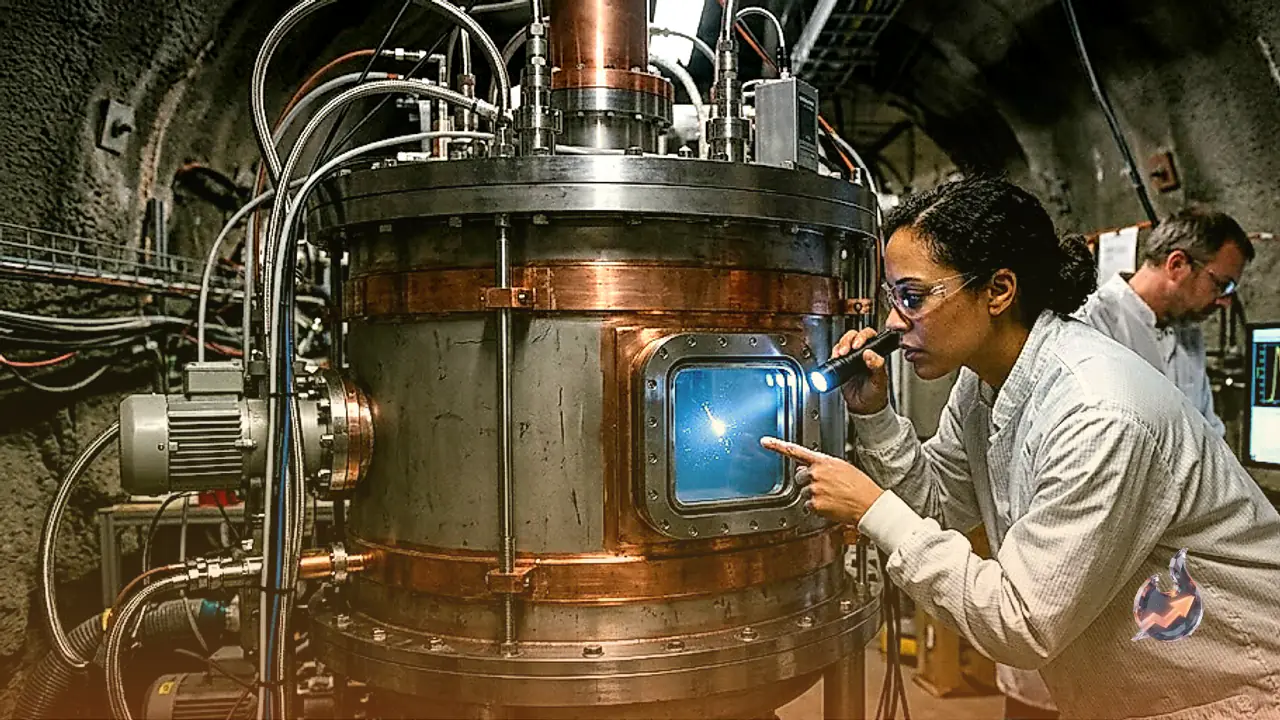

Astrophysicists seeking to unmask the hidden architecture of the universe have detected an extraordinary anomaly deep inside a subterranean laboratory. Monitors at the Sanford Underground Research Facility, located in South Dakota, recorded a sudden and unexplained recoil within a tank of liquid xenon. A single atomic nucleus absorbed kinetic energy from an unseen source, generating a signal that aligns remarkably with theoretical models of dark matter. While researchers urge extreme scientific caution, the event represents one of the most compelling physical observations to date in the ongoing search for Weakly Interacting Massive Particles, commonly known as WIMPs.
Unraveling the Cosmic Mystery of Dark Matter
Dark matter remains one of the most fundamental yet baffling puzzles in modern science. Despite constituting roughly 85 percent of all matter in the observable universe, it has evaded direct detection for decades because it emits, absorbs, and reflects no electromagnetic radiation. Humans cannot see dark matter with conventional telescopes or optical sensors. Its presence is inferred almost entirely through its colossal gravitational influence. In the early epochs of the cosmos, the gravitational pull of dark matter acted as a scaffold, clumping ordinary hydrogen and helium atoms together to initiate the birth of stars, galaxies, and the vast cosmic web that structures the universe today.
Without dark matter, galaxies would lack the gravitational glue required to hold their rapidly spinning outer stars in orbit. Yet, despite its overwhelming presence, physicists have not established the precise physical composition of this invisible realm. Theoretical proposals range from exotic solitary particles to complex hidden sectors of interacting subatomic entities, and even primordial black holes formed shortly after the Big Bang. Among these theories, the WIMP hypothesis has long stood out as the leading candidate. According to this framework, dark matter consists of massive subatomic particles that interact with normal matter primarily through gravity and an extremely faint weak nuclear force.
A Lone Anomaly at the Sanford Underground Facility
Because WIMPs are theorized to permeate our galaxy, trillions of them ought to be streaming harmlessly through the Earth every second without leaving any trace. On rare occasions, however, a WIMP might collide head-on with an atomic nucleus of conventional matter, transferring a tiny fraction of its kinetic energy and causing the nucleus to recoil. Detecting such a collision requires extreme isolation from cosmic rays and environmental radiation, which is why the experiment at the Sanford Underground Research Facility (SURF) in South Dakota was constructed deep below the surface of the Earth.
During a monitoring campaign spanning 220 days between 2023 and 2024, the sensitive detectors surrounding the liquid xenon tank recorded exactly one such anomalous recoil event. A xenon nucleus unexpectedly acquired energy and bounced back, producing a distinct physical signature. The research team has published their detailed observations as a preprint, which means the study has yet to undergo formal peer review. Furthermore, the findings were shared directly with global experts at the 2026 TeV Particle Astrophysics Conference held in Japan.
Project leaders have been deliberate in tempering expectations. "With only one event, we do not want to get ahead of ourselves," Rick Gaitskell, a professor at Brown University and a senior member of the research team, stated. He emphasized that the collaboration is not officially claiming a confirmed discovery of dark matter, but rather presenting an intriguing anomaly to the wider scientific community for rigorous scrutiny and independent input.
Filtering Background Noise and Estimating Particle Mass
In high-precision particle physics experiments of this magnitude, unexpected signals can sometimes arise from mundane background sources such as trace radioactive decays or thermal noise. To prevent false positives, the facility at SURF utilizes sophisticated multi-layered shielding and advanced filtering algorithms designed to identify and eliminate interference from known particles. Remarkably, the single recoil event recorded between 2023 and 2024 withstood every rigorous background check applied by the team. None of the established environmental radiation profiles or detector artifacts could account for the observed energy transfer.
"We understand our detector and the backgrounds so well that even a single outstanding event is important," Sam Eriksen, a senior researcher at the University of Bristol and the lead author of the study, noted. He explained that because interactions between dark matter and normal matter are expected to be extraordinarily rare, the initial verification of WIMPs would naturally begin with just a handful of isolated detections.
If future data confirms that this event was indeed caused by a dark matter collision, it provides sufficient preliminary data for theoretical physicists to begin mapping out the fundamental properties of the particle. Initial calculations based on analyzed WIMP models suggest that the particle responsible for the recoil possesses a mass approximately 200 times greater than that of a proton. Such a measurement could shed crucial light on how dark matter couples with standard subatomic particles. This cautious approach mirrors previous milestones in astrophysics, such as in November 2025, when a team of Japanese astronomers observed potential dark matter signatures within the Milky Way and similarly urged the scientific community to maintain measured expectations until further empirical confirmation is gathered.