























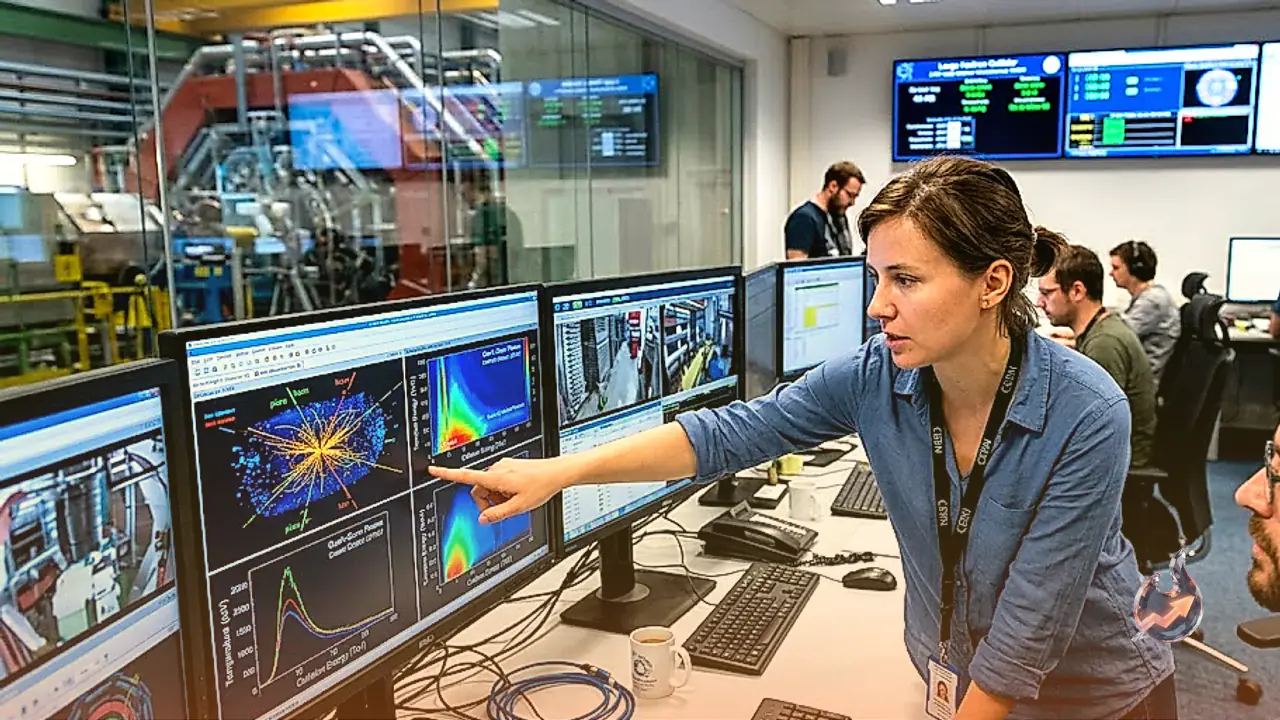

In an effort to decode the mysteries surrounding the birth of the cosmos, researchers have achieved a significant milestone in particle physics. Scientists at the European Organization for Nuclear Research, widely known as CERN, have demonstrated that the primordial plasma from the dawn of time can be produced through much smaller particle collisions. Because natural reservoirs of this ancient material no longer exist, these miniature cosmic impacts offer a rare window into the universe's formative moments.
Understanding the Building Blocks of Matter
Examining this breakthrough requires looking at the fundamental components of physical reality. Quarks serve as the primary constituents that form protons and neutrons, which subsequently act as the foundational bricks of atoms and all existing matter. Meanwhile, gluons function precisely as their name implies by binding quarks tightly together.
During the initial microseconds following the origin of the universe, quarks and gluons remained unbound within protons and neutrons, instead existing as an intensely hot soup of plasma. As space continued to expand and cool down, this primordial material lost thermal energy, allowing quarks to condense into larger, stable particles.
Pushing the Boundaries of Atomic Scale
After decades spent analyzing quark-gluon plasma through massive nuclear collisions, physicists are actively testing the limits of this peculiar state of matter. Specifically, researchers are investigating how drastically a collision can be scaled down while still producing a particle collection that flows like a liquid droplet.
According to findings published in Physical Review Letters, CERN and an international consortium of collaborators successfully generated the substance using oxygen-16 and neon-20. Both elements weigh less than a tenth of a lead atom, which was previously regarded as one of the lightest nuclei capable of producing this extreme state.
Insights Into Cosmic Evolution
You Zhou, a researcher at the Niels Bohr Institute in Denmark and a coauthor of the study, noted in a press release that the team successfully pushed boundaries regarding how small atomic nuclei can be while still recreating primordial matter. He described the achievement as a little big bang that expands human understanding of the fundamental conditions required for matter to transition into this extreme phase.
The research team observed that despite the remarkably small dimensions of the oxygen and neon nuclei, the resulting impacts generated signatures consistent with quark-gluon plasma expectations. For a fleeting moment, the generated matter expanded collectively like a fluid before cooling off and reverting back into conventional particles.
Zhou expressed optimism that these findings will clarify how plasma behaved during the opening moments of the universe and how it eventually evolved into the complex forms of matter that populate the physical world today.