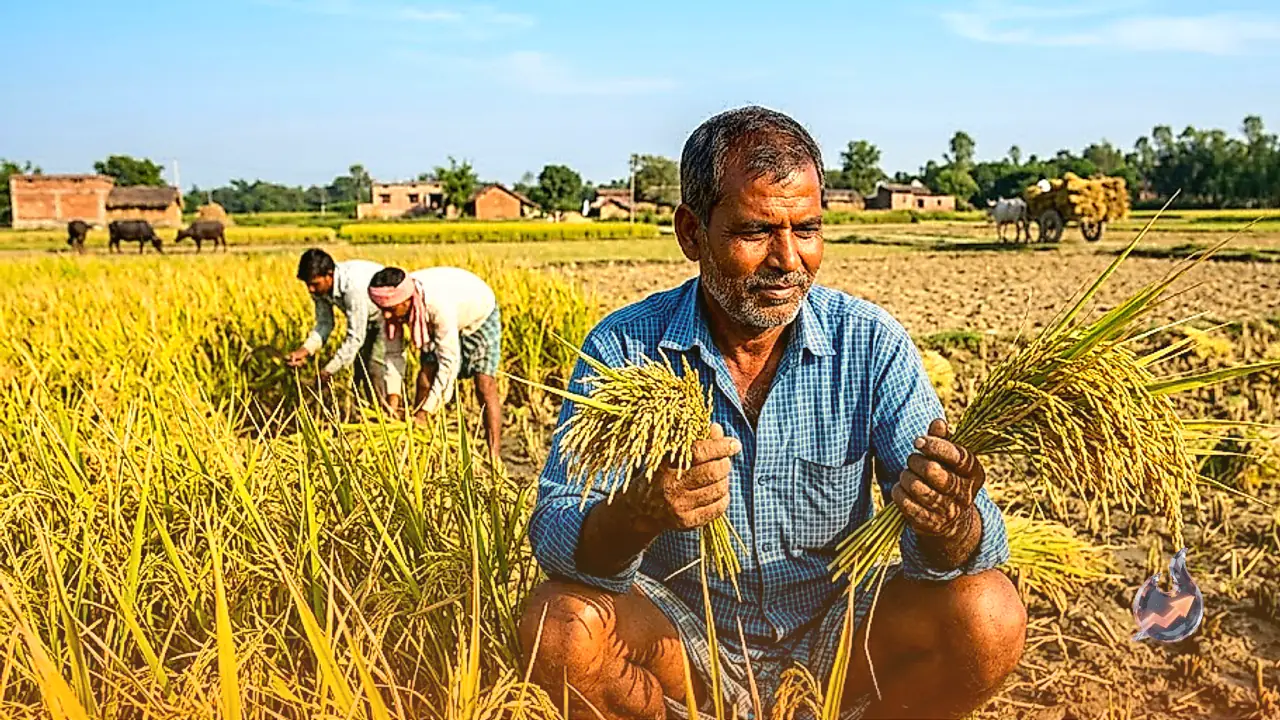


















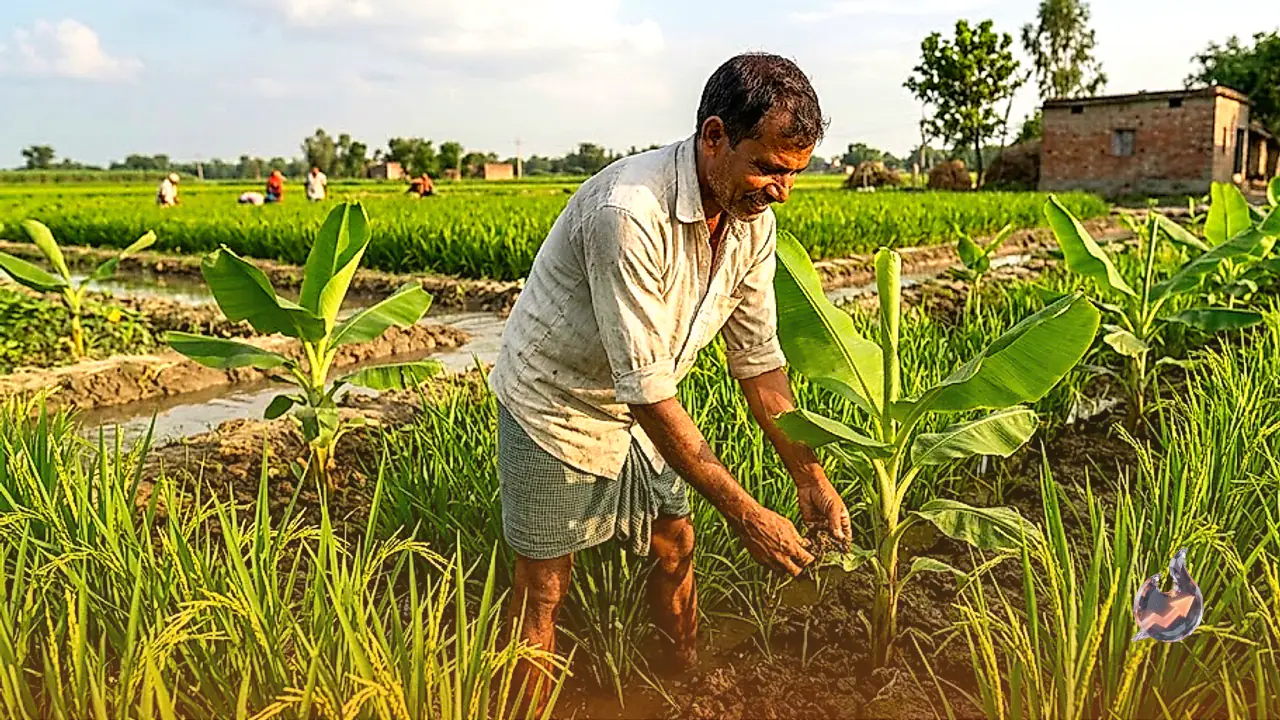

Rising agricultural input expenses and widespread reliance on synthetic sprays often create serious financial pressure for rural growers. In the Mirzapur Tiwari Purwa village of Bahraich district, farmer Brijesh Kumar has taken an unconventional route that challenges prevailing farming habits. While many cultivators regularly pour heavy volumes of chemical fertilizers and pesticides into their fields, Brijesh Kumar has raised a lush, thriving stand across two bighas of land without adding any chemical or organic fertilizers.
A Structured Intercropping Setup for Banana and Paddy
The core of Brijesh Kumar's initiative lies in an intercropping pattern combining banana trees with paddy. He carefully plotted his two bighas into organized rows to ensure balanced growth. The field features single lines of banana plants, and within the open gaps between them, he transplanted two to three rows of paddy. This layout allows both crops to develop side by side without crowding or hindering each other. Both plant varieties currently exhibit strong, healthy foliage and steady vegetative development across the plot.
Minimal Expenditure and a Working Zero-Cost Framework
By completely eliminating expensive synthetic compounds, organic manure purchases, and pesticide treatments, Brijesh Kumar managed to bring production expenses down to a nominal figure. His cash outlays were restricted solely to planting essentials. He spent ₹600 on paddy seeds, while the labor required for transplanting the paddy cost ₹1,500. Taking all inputs into account, the total expenditure for the two-bigha cultivation remained between ₹2,000 and ₹3,000, presenting an affordable, low-cost operational blueprint for smallholder farming.
Origins of the Idea and Practical Performance
Explaining how the initiative began, Brijesh Kumar noted that agricultural officials frequently visited the village to advocate for organic farming practices. Their discussions prompted him to consider an alternative test: what would happen if a farmer applied neither chemical nor organic inputs to the soil? Driven by that curiosity, he launched this field trial on his own land.
According to Brijesh Kumar, while one might spot subtle visible differences when comparing these plants to heavily fertilized crops, the outcomes remain remarkably satisfying when viewed against the negligible money invested. The chemical-free experiment has drawn widespread interest across the local farming community, where both the banana and paddy crops continue to progress toward maturity. The grower expresses confidence that this minimal-expense approach will yield a healthy financial return at harvest time.