





















Military tensions across the Korean Peninsula have heightened following North Korea's successful trial of a strategic cruise missile designed to strike targets in a direct vertical dive at a 90-degree angle. The test conducted by the missile administration was focused on verifying the weapon's terminal flight accuracy and vertical strike mechanics. Fitted with a medium-sized dispersal submunition warhead, the deployment has triggered sharp concern in neighboring South Korea and allied capitals, as the technical design is widely viewed as a direct countermeasure against fortified subterranean fortifications and mountain redoubts.
The Mechanics of Vertical Terminal Flight
Conventional cruise missiles generally travel parallel to terrain contours or sea surfaces, making impact along low or oblique trajectories. In contrast, the system tested on Monday alters its vector drastically: upon positioning itself directly above its designated coordinate, the missile pivots into a sharp 90-degree downward plunge. Falling along this vertical axis harnesses the full gravitational pull of the earth, drastically multiplying its terminal velocity and kinetic impact force. Technicians conducted the trial to validate how accurately the guidance system maintains alignment during these demanding final seconds before ground contact.
Dispersal Warhead Reach and Destruction Footprint
The strategic missile payload incorporates a medium-sized cluster warhead designed to detonate mid-air and scatter hundreds of submunitions across a vast kill zone. According to technical specifications released by warhead specialists, the submunitions possess the capacity to devastate an area spanning 5 to 6 hectares, which corresponds to roughly 12 to 15 acres. Pyongyang has been systematically scaling up the integration of submunition armaments into its wider military posture. This latest launch followed another cluster bomb trial conducted on tactical ballistic missiles on Saturday, accompanied by an announcement that multiple variants of such systems will enter active military service before the end of the year.
Targeting Subterranean Fortifications Across the Border
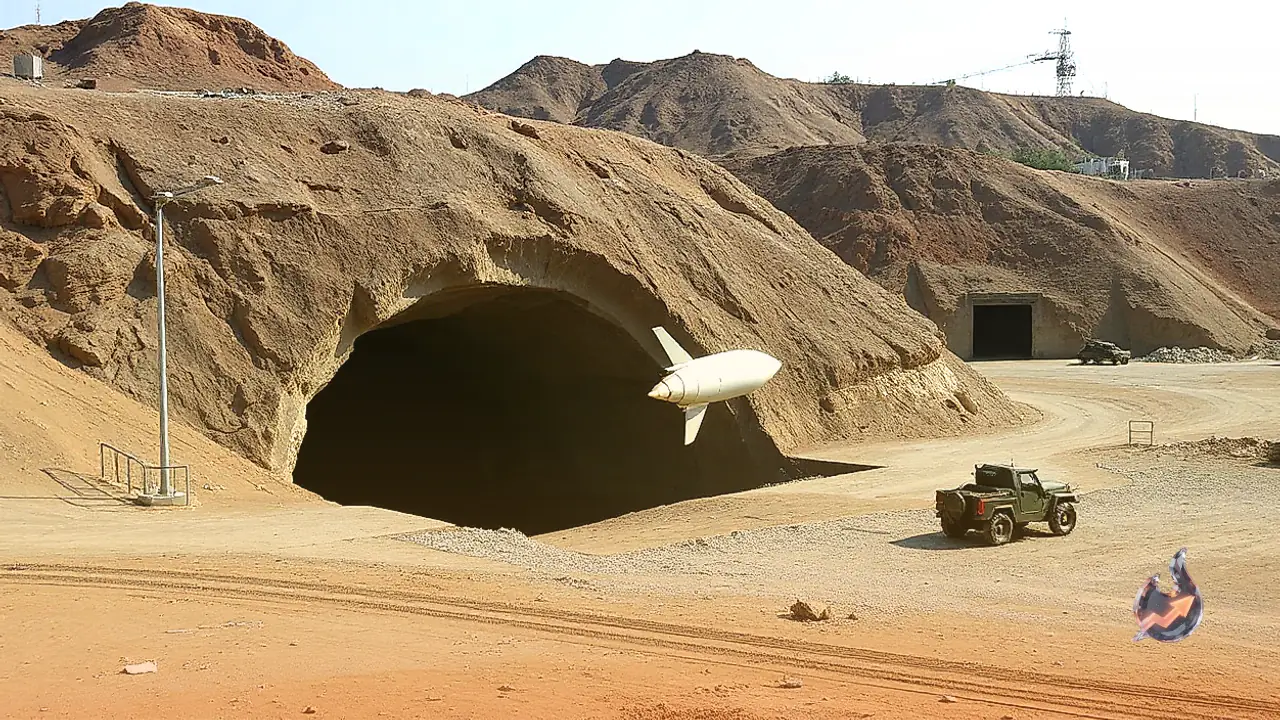
Shin Jong-woo, a military analyst at the Seoul-based Korea Defense and Security Forum, stated that this specific flight profile was developed to compromise underground military installations and mountain tunnel portals across South Korea. To guard against potential strikes, South Korean and United States forces have built sensitive command centers, munitions depots, and operational bunkers deep within granitic mountains and heavy concrete redoubts. Oblique cruise missile strikes frequently glance off reinforced slopes or have their blast pressure absorbed by external barriers. A vertical dive, however, plunges straight through roofs, vertical shafts, and subterranean entrances, destroying critical hardened infrastructure that horizontal projectiles cannot breach.
Strategic Intent and Counter-Readiness in Seoul
The head of North Korea's missile administration explained that enhancing actual combat capacity has become vital in response to fast-shifting international security environments, arguing that advanced weapon platforms are necessary to safeguard national sovereignty against external coercion. South Korean defense authorities have stepped up tracking and operational vigilance across the Demilitarized Zone. Military spokesperson Captain Jang Do-young stated publicly that South Korean forces maintain total readiness to respond swiftly and decisively to any operational provocation. Furthermore, Seoul emphasized that its armed forces already deploy striking arsenals and guidance capabilities far superior to the vertical dive cruise technology demonstrated across the border.