





















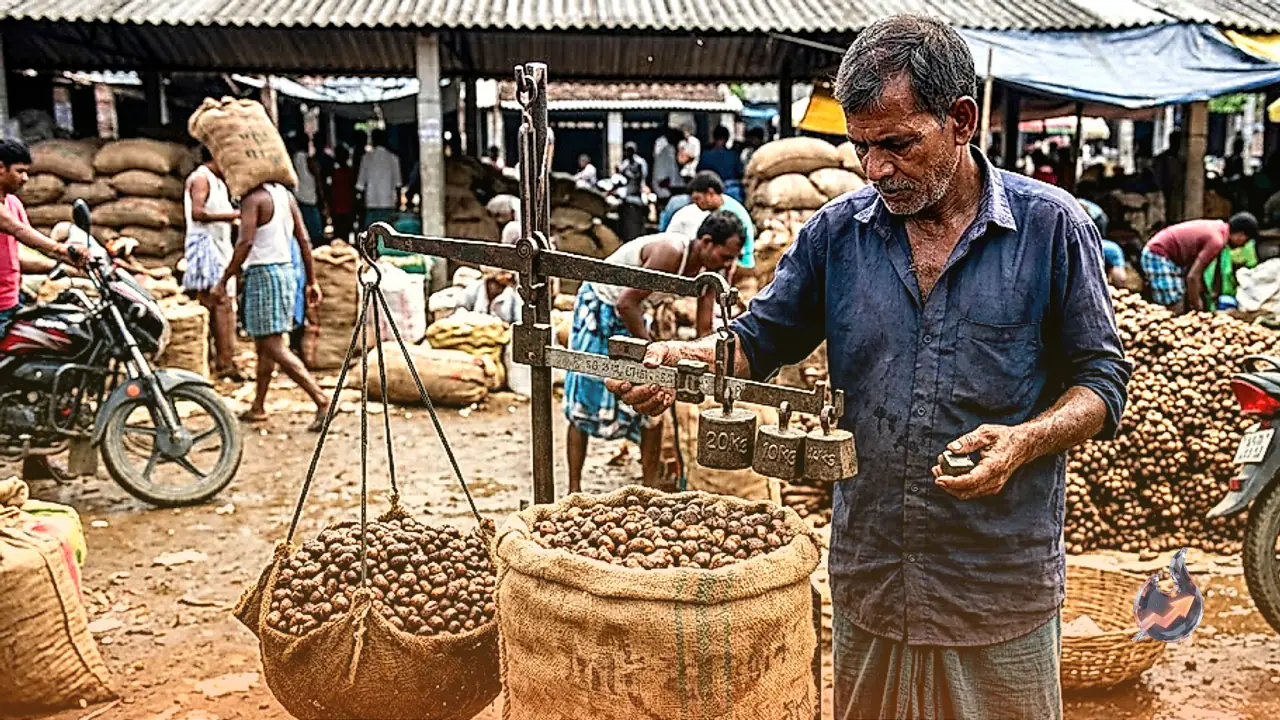

Across most agricultural markets in India, the traditional unit of maund is universally understood as 40 kilograms. Yet in the makhana heartland of Purnea in Bihar, this age-old metric follows an entirely different formula. When raw makhana seeds, locally known as gudiya, are bought and sold, a single maund is calculated as 64 kilograms. This distinct commercial practice has evolved out of the physical nature of the crop and the heavy water content present in freshly harvested seeds.
The Math Behind Water Retention and Raw Seeds
Makhana is an aquatic crop whose entire cultivation takes place in ponds, stagnant wetlands, and flooded lowlands. Vijay Kumar Singh, an experienced makhana farmer from Thada village in the Harda area of Purnea, explains that the post-harvest chain of makhana differs fundamentally from standard field crops. When farmers harvest gudiya from the bed of water bodies, the seeds remain completely soaked and hold a significant volume of trapped water.
Because fresh gudiya cannot be treated as dry agricultural produce, trading it at the standard 40 kg rate would mean paying full price for heavy moisture that evaporates during drying. To reflect the true value of the actual seed, local buyers and farmers peg one maund at 64 kilograms. Vijay Kumar Singh notes that farmers do not sell finished popped makhana directly to retail markets. Instead, raw gudiya is handed over to local traders and processors, who put the raw harvest through laborious drying, grading, roasting, and popping stages before producing the crisp white puffs demanded across domestic and overseas markets.
A Distinct Calculation for Harvest Labor Wages
The unusual weight calculation extends directly into the remuneration system for farm laborers who harvest the crop. Extracting makhana seeds from muddy water beds requires immense physical stamina, and compensating workers also involves accounting for water weight.
According to local farming norms, when a laborer extracts 12.5 kilograms of raw gudiya from the water, their wage settlement is calculated on the basis of 5 kilograms. This fixed conversion ratio balances the initial heavy moisture against the net yield, ensuring that labor contracts reflect practical processing realities. It demonstrates how every tier of makhana farming, from field extraction to market wholesale, operates on customized measurements designed specifically for water-logged produce.
White Gold Driving Bihar's Rural Economy
Often referred to as the 'White Gold' of Bihar, makhana has emerged as a cornerstone of agricultural livelihood across Purnea and adjoining districts. From the arduous task of gathering submerged seeds to the skilled craft of popping them over high-heat earthen furnaces, the crop supports thousands of rural families. The 64 kg per maund metric stands as a testament to the practical wisdom of local commerce, where trade conventions adapt precisely to the nature of the crop itself.