

















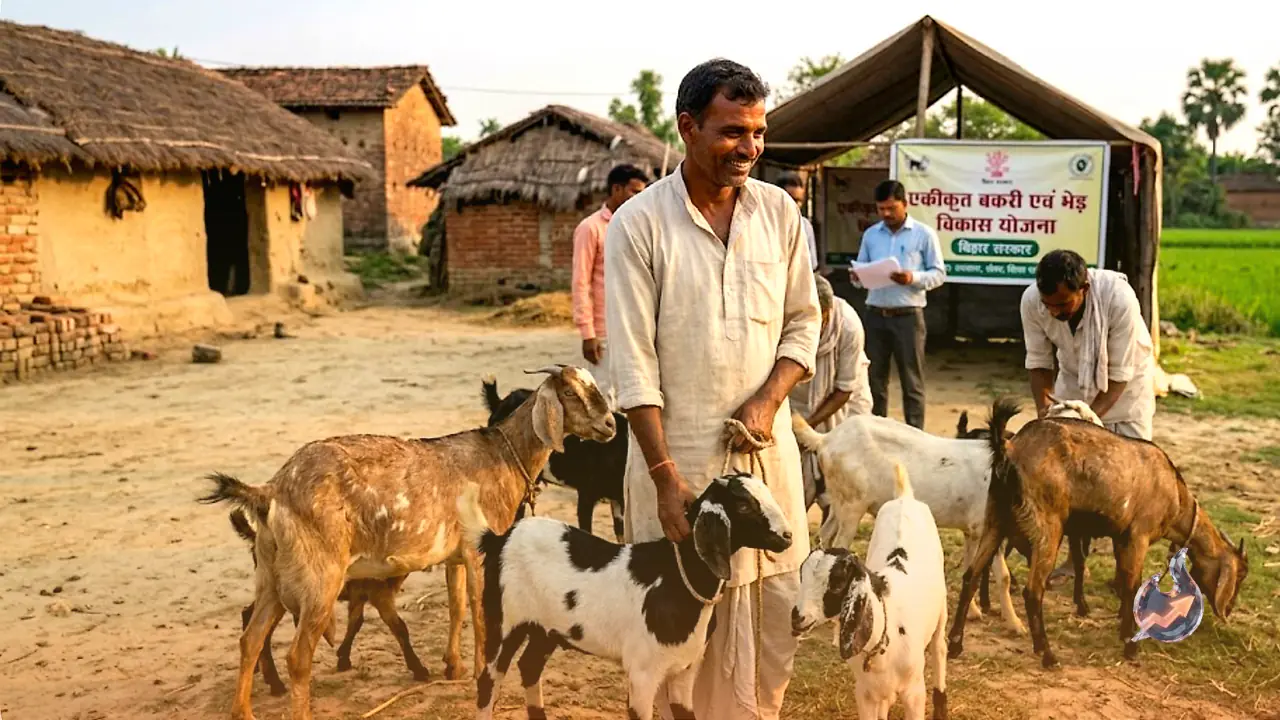

The landscape of animal husbandry in Bihar is witnessing significant growth. Across various parts of the state, people are increasingly moving towards businesses like goat rearing, poultry farming, and cattle rearing alongside traditional agriculture. In this evolving environment, the state government is standing firmly with aspiring livestock farmers. Several schemes are being operated by the government with the primary objective of establishing animal husbandry as a successful business with minimal investment. One such key initiative is the 'Integrated Goat and Sheep Development Scheme,' which presents a lucrative opportunity for the residents of the state.
Key features of the scheme
The Integrated Goat and Sheep Development Scheme is an ambitious initiative of the state government. Under this program, farmers and livestock owners in the state are provided with goats at subsidized rates. As per the scheme guidelines, every eligible individual is provided with three goats for self-employment. This subsidy is determined based on the applicant's caste category. Candidates from Scheduled Castes and Scheduled Tribes receive a grant of up to 90 percent, while for the General category and Other Backward Classes (OBC), the subsidy is set at 80 percent. A specific target is assigned to each district every year to facilitate the distribution of these goats.
Application and selection process
According to Dr. Rani, the Assistant Poultry Officer stationed at the Jahabad Animal Husbandry Office, the process to avail the benefits of this scheme is entirely transparent. Each year, the district receives a specific target for this scheme. Interested candidates can apply online through the official departmental portal. Once the application process is complete, a departmental screening is conducted, based on which beneficiaries are selected. Once the selection is finalized, the government provides the goats to the farmers through an authorized agency. Candidates can also register their applications from any nearby cyber cafe for their convenience.
The mathematics of costs and subsidies
Shedding light on the financial aspects, it was shared that for the 2025-26 session, the district received a total target of 85, out of which 56 beneficiaries were provided with benefits based on the available allocation. Among these 56 beneficiaries, 39 were from the Scheduled Caste and Scheduled Tribe categories, while 17 were selected from the General category. From a financial perspective, if the official price of three goats is set at 15000 rupees, then a beneficiary from the General category is required to contribute 3000 rupees. Meanwhile, a beneficiary from the Scheduled Caste category receives these three goats at a concessional rate of just 1500 rupees. However, the allocation for the 2026-27 session is still awaited.