




















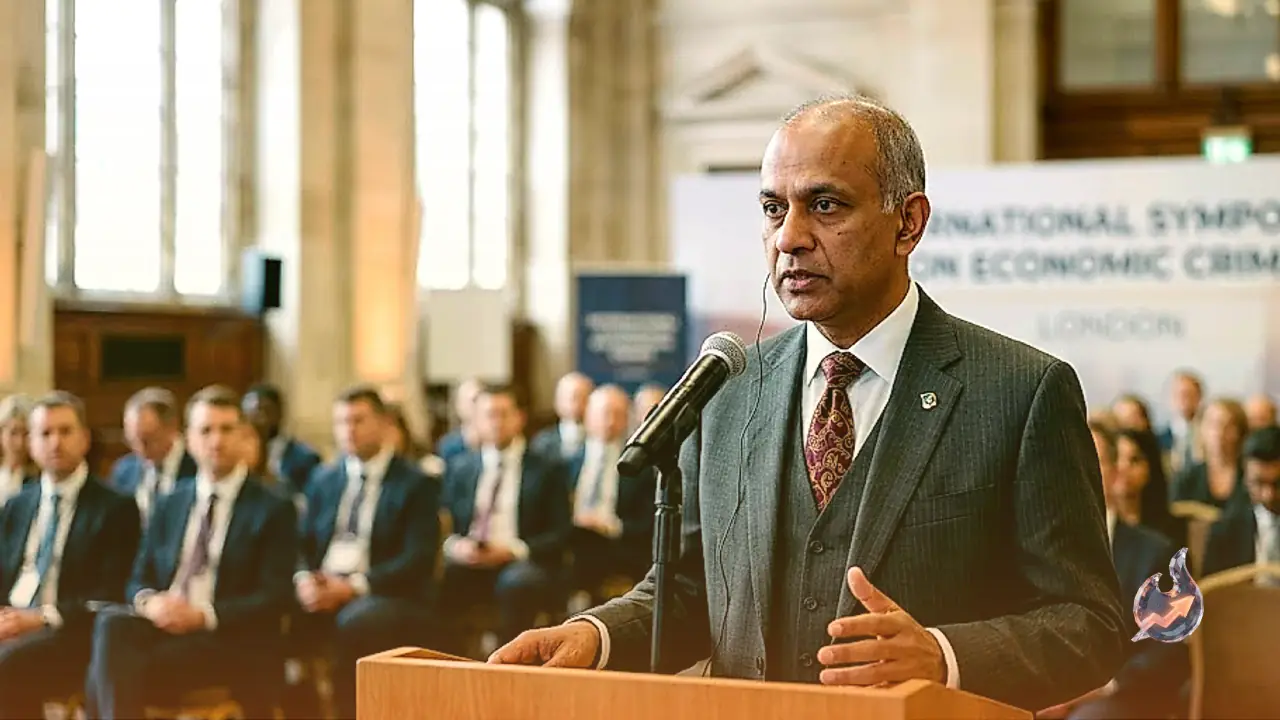

Every year, the sheer volume of global money laundering is staggering enough to purchase a brand-new laptop for every single person among the world population of roughly eight billion. Yet, when examining the aftermath of such massive financial corruption, a grim question remains: how much of this unaccounted wealth actually finds its way back to the national treasury? Supreme Court Justice Surya Kant addressed the profound gravity of this challenge during an international economic crime symposium in London, revealing that out of every 100 rupees acquired through unlawful means, barely one rupee is ever successfully recovered. This stark reality raises pressing concerns about where the remaining fortune vanishes and why retrieving it proves to be an immensely formidable task for global law enforcement agencies.
Addressing the 43rd International Symposium in London
Justice Surya Kant delivered these crucial remarks while speaking at the concluding ceremony of the 43rd International Symposium on Economic Crime held in London. Throughout his address, he shed light on a wide array of escalating financial threats, ranging from large-scale money laundering and illicit asset recovery to the rapidly multiplying menace of digital arrest scams. Speaking before an audience of international legal experts, scholars, and policymakers, he emphasized that financial crimes in the modern era have evolved far beyond domestic boundaries, directly threatening the stability of the global financial architecture and demanding unified cross-border legal responses.
Laundering Scale Equal to Purchasing Laptops for Billions
Highlighting the astronomical scale of global money laundering estimates, Justice Kant noted that if current projections hold true, the total amount of money laundered worldwide in a single year could easily buy a standard laptop for nearly every human being on Earth, with funds still left over. The core purpose of this striking comparison was to illustrate the colossal magnitude of the problem, underscoring that money laundering is no longer confined to isolated jurisdictions or single investigative agencies. Instead, its far-reaching consequences deeply penetrate the core of international financial systems, undermining economic integrity on a planetary scale.
Fewer Than One Rupee Recovered per 100
Drawing attention to another deeply troubling dimension of financial crime, Justice Kant pointed out that even under the most optimistic and generous estimates, less than one rupee out of every 100 rupees amassed through illegal channels is ever recovered. This stark statistic highlights that tracking down criminal proceeds is only part of the battle; successfully seizing and repatriating those funds remains an even greater obstacle. Illegally acquired fortunes frequently traverse international borders, slipping through multiple foreign accounts, shell companies, and complex financial instruments before authorities can freeze them.
The Vital Role of Cross-Border Legal Cooperation
Justice Kant underscored the critical importance of robust international legal cooperation, describing it as an indispensable tool in the fight against financial crime. He stated that Mutual Legal Assistance Treaties (MLATs) with foreign jurisdictions, regardless of how imperfect their underlying machineries and bureaucratic procedures might be, serve as much more reliable mechanisms for recovering illicit assets compared to traditional extradition proceedings. Furthermore, he stressed that unlawfully obtained wealth rarely remains stationary in the jurisdiction from which it was originally stolen, making international judicial partnerships essential for effective asset tracing and repatriation.
India's Legislative Framework Against Economic Crime
Detailing India's institutional preparedness in combating economic offenses, Justice Kant highlighted the country's progressive legal frameworks. He cited the Insolvency and Bankruptcy Code (IBC) 2016 as a prime example of a mechanism that operates concurrently with criminal proceedings. According to his assessment, the Indian judicial system has consistently facilitated civil recovery avenues despite the prolonged delays often associated with criminal trials. This multi-pronged legal approach is specifically designed to ensure that the pursuit of illegal asset recovery is not prematurely halted simply because a lengthy criminal prosecution is underway.
Rising Threat of Digital Arrest Scams
In his comprehensive address, Justice Kant also drew attention to the alarming surge in digital arrest scams. He explained how fraudsters exploit advanced communication technologies by initiating video calls, impersonating law enforcement officers, judicial authorities, or senior government officials, and terrifying victims into surrendering their hard-earned savings. Responding to this emerging menace, he noted that the judiciary has directed both central and state authorities to thoroughly assess the scope of such cyber frauds. Discussions are actively underway to classify these deceptive acts as distinct criminal offenses and to formulate proportionate punishments based on the exact magnitude of the financial loss inflicted.
Judicial Proactivity Beyond Parliamentary Legislation
Concluding his address, Justice Kant asserted that when novel economic and cyber offenses emerge, the Indian judiciary refuses to remain a passive bystander waiting for parliamentary legislation. Instead, the courts often step in proactively to address urgent societal threats. He pointed out that the judicial response to sophisticated frauds like digital arrest reflects a broader institutional pattern where legal systems must react swiftly to unprecedented criminal methodologies. Ultimately, he framed India's contemporary approach to tackling economic crime as a mature, multi-layered architecture where laws, specialized institutions, and proactive judicial doctrines work in close coordination.