





















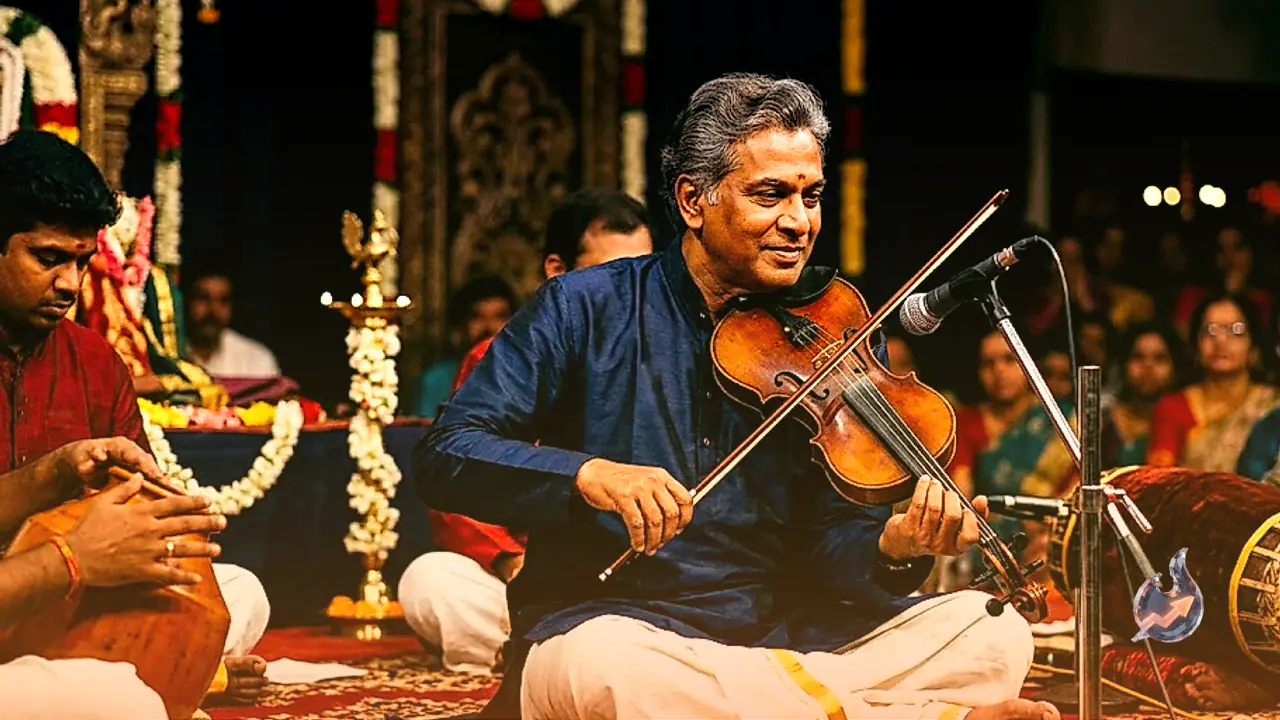

Few instrumentalists have reshaped the contours of classical music as decisively as Lalgudi Jayaraman. Born on September 17, 1930, into a lineage immersed in Carnatic heritage across multiple generations, his artistic destiny was mapped out almost from birth. His father, Lalgudi V.R. Gopala Iyer, who was himself an accomplished musician, took on the responsibility of being his primary guide and mentor. Recognizing the boy's latent gifts, he initiated rigorous musical training when Jayaraman was barely out of toddlerhood. Under this uncompromising discipline, the violin ceased to be an external instrument and naturally evolved into an inseparable extension of his everyday existence.
Overcoming the Lack of a Radio to Learn Melodies by Heart
During his formative years in Lalgudi, an area in Tamil Nadu, technological conveniences were virtually non-existent in his household, which lacked even a basic radio set. Undeterred, the young Jayaraman sought out neighbors' homes or gathered around municipal speakers in public squares to catch evening broadcasts of Carnatic concerts on All India Radio. He treated every broadcast as an impromptu classroom. Listening with fierce concentration, he committed the melodies, gamakas, and lyrical phrasing to memory on the spot, running straight home afterward to recreate every note upon his instrument before the impressions could fade.
Midnight Practice in the Silence of Village Life
Jayaraman recalled that whenever a broadcast concluded around 9 pm, he would sprint back through the dark and immediately devote several uninterrupted hours to reproducing the musical concepts he had just internalized. The quiet rustic atmosphere of his village became an essential catalyst for his intense focus, offering an environment free from modern urban clamor where endless riyaz could unfold smoothly. His hunger for authentic music ran so deep that around the age of 10, he began boarding trains unaccompanied just to attend live performances and absorb master performers in person.
Accompanying Legends and Crafting the Acclaimed 'Lalgudi Bani'
Jayaraman's preternatural maturity on the strings soon opened doors to the highest performance circles. While still very young, he began providing accompaniment to vocal stalwarts of the era, including Madurai Mani Iyer and GN Balasubramaniam. His extensive childhood habit of internalizing vocal compositions gave him an instinctive feel for the nuances, respiratory cadence, and structural dynamics of vocalists. Over time, this deep insight led him to pioneer an entirely original school of playing known as the 'Lalgudi Bani'. The hallmark of this technique was its ability to mimic human singing with breathtaking fidelity. Through his bow, melodic scales, complex rhythmic cycles, and evocative lyrics coalesced so seamlessly that listeners could experience an entire narrative unfolding purely through sound.
Prolific Compositions, Teaching Pedagogy, and National Honors
Jayaraman's genius extended far beyond interpretation into groundbreaking original composition. He authored enduring varnams and tillanas, alongside the ambitious epic suite 'Suladi Sapta Tala Ramayana'. As a dedicated guru, he shaped several accomplished disciples, while his son Lalgudi G.J.R. Krishnan and daughter Lalgudi Vijayalakshmi carried forward the family's artistic lineage on concert stages worldwide. In recognition of his enduring mastery, the Government of India conferred upon him the Padma Shri in 1972 and the Padma Bhushan in 2001. He received the Sangeet Natak Akademi Award in 1978 and was later elected a Fellow of the Sangeet Natak Akademi in 2009, a pinnacle recognition within Indian performing arts. In 2008, the Music Academy, Madras honored him with its Lifetime Achievement award. Following a stroke in 2006, he withdrew from concert platforms, yet his creative engagement as a composer and mentor remained unbroken until his death at the age of 82 on April 22, 2013.