






















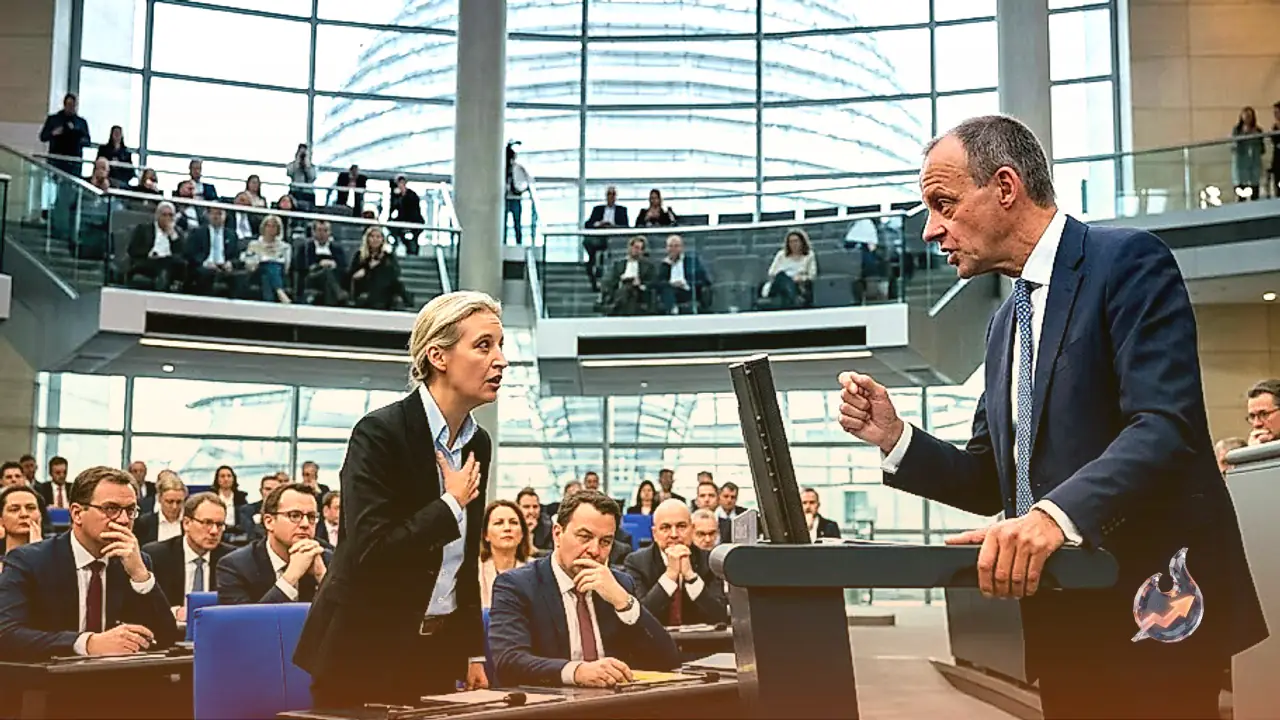

A high-stakes political confrontation unfolded inside the German Bundestag as Chancellor Friedrich Merz clashed directly with Alternative for Germany (AfD) co-leader Alice Weidel. The stormy parliamentary debate marked their first face-to-face encounter since the anti-immigration party achieved a historic electoral victory in the eastern state of Saxony-Anhalt. Addressing lawmakers during a tense session, Chancellor Merz delivered a scathing assessment of the AfD, describing the party as a destructive force whose proposed deportation strategies amounted to a form of ethnic cleansing directed against skilled foreign workers vital to the national economy.
High-Stakes Clash at the Parliamentary Podium
The atmosphere inside the Bundestag turned volatile from the opening moments of the session. As the leader of the primary opposition party, Alice Weidel launched a scathing attack on the governing coalition. She declared that voters in Saxony-Anhalt had delivered an unmistakable verdict against Chancellor Merz and his alliance with the Social Democrats. Weidel asserted that the administration's policies were pushing the country toward financial ruin and insisted that the chancellor no longer retained a mandate to govern. She pointed to rising incidents of knife violence and growing public anxiety regarding safety at railway hubs and public transit as evidence of systemic governance failures caused by mass migration.
Responding firmly to the allegations, Chancellor Merz rejected Weidel's characterization of the administration's record and launched a targeted counterattack against the AfD's core platform. Merz argued that the AfD actively undermines national interests by maintaining close alignments with Russia and pursuing policies that threaten social cohesion. He focused heavily on the party's proposed remigration initiative, emphasizing that one out of every six skilled workers in Germany possesses a migration background. Merz stated that implementing the AfD's agenda would essentially result in ethnic cleansing across skilled trades, discriminating against essential workers based purely on their origin and skin colour.
Landmark Electoral Outcomes in Saxony-Anhalt
The clash in Berlin followed an unprecedented electoral outcome in Saxony-Anhalt, where the AfD secured nearly 44% of the total vote. In contrast, Chancellor Merz's conservative Christian Democratic Union (CDU) suffered a dramatic decline, seeing its historical share of the vote halved down to 17.2%. The result represents the strongest performance by a far-right political party in any of Germany's 16 federal states since the end of World War II. Chancellor Merz publicly acknowledged the gravity of the outcome, describing it as a seismic shift that has permanently altered the nation's political landscape.
Despite achieving a dominant victory in Saxony-Anhalt, the AfD fell three seats short of securing an absolute majority in the state assembly. This shortfall leaves the process of forming a functional regional government in considerable doubt. Mainstream political leaders have reiterated their refusal to enter formal alliances with far-right groups, creating a complex arithmetic challenge for state governance following the historic vote.
Economic Risks and Threats to Essential Public Services
Throughout his address, Chancellor Merz drew a sharp line between lawful, economically productive immigrants and individuals lacking valid residency rights. He clarified that while federal authorities recognize the necessity of enforcing deportation orders for irregular migrants who lack legal authorization to remain in the country, the government remains committed to protecting workers who contribute directly to national economic stability.
Merz warned that enforcing sweeping deportation directives would trigger immediate operational crises across vital sectors of society. He cautioned that without the continued contributions of foreign workers, critical infrastructure—including hospitals, residential care facilities, clinics, and hospitality venues—would be unable to function. He accused the AfD of exploiting public anxieties without offering viable policy solutions, reinforcing his stance that the party remains inherently destructive to Germany's future prosperity.
Coalition Arithmetic and the Political Firewall
Following the election results, attention has shifted to potential coalition scenarios in Saxony-Anhalt. Prior to the vote, the AfD's candidate for state premier, Ulrich Siegmund, had publicly insisted that he would only take office if his party won an outright majority. However, within hours of the polls closing, party strategists began exploring options to assemble a working majority with external partners, a pivot that Merz highlighted as evidence of political opportunism.
Reports indicate that the AfD has expressed willingness to collaborate with other political entities, including the left-wing populist party BSW, provided they agree to support Siegmund's bid for premier. Furthermore, senior AfD figures in Saxony-Anhalt suggested that the CDU could join them in government if Merz's party agreed to dismantle the longstanding political firewall, known locally as the Brandmauer. This unwritten rule has historically prevented traditional democratic parties from forming alliances or entering coalitions with far-right political factions.
Security Classifications and Global Political Reactions
The AfD's electoral success in Saxony-Anhalt comes despite significant scrutiny from federal authorities. Domestic intelligence agencies in Germany have formally classified the AfD's regional chapter in Saxony-Anhalt as a right-wing extremist organization. Despite this designation, the party's platform—centered around aggressive deportation campaigns and restrictive immigration controls—resonated strongly with a large segment of the local electorate.
The election outcome also attracted international attention, notably from US President Donald Trump. Commenting on the political shift, Donald Trump stated that the populist movement in Germany had achieved a major breakthrough, attributing the electoral gains directly to what he characterized as extremely flawed immigration regulations. The comments added an international layer to an already intense domestic political debate surrounding national security and border policy.
Parliamentary Disruption and Speaker Intervention
The debate inside the Bundestag chamber was marked by continuous interruptions, with AfD representatives frequently shouting down speakers and heckling the chancellor during his presentation. As the noise levels escalated, parliamentary proceedings were severely disrupted, forcing leadership to intervene directly to restore order.
Bundestag President Julia Klöckner issued a stern reprimand to unruly members, threatening to exercise her authority to remove disruptive MPs from the chamber if decorum was not restored. Intervening during a particularly boisterous exchange, Klöckner reminded assembled lawmakers of their professional obligations, stating bluntly, "We are not on a football pitch." Her intervention temporarily calmed the chamber, allowing the parliamentary session to continue.