

















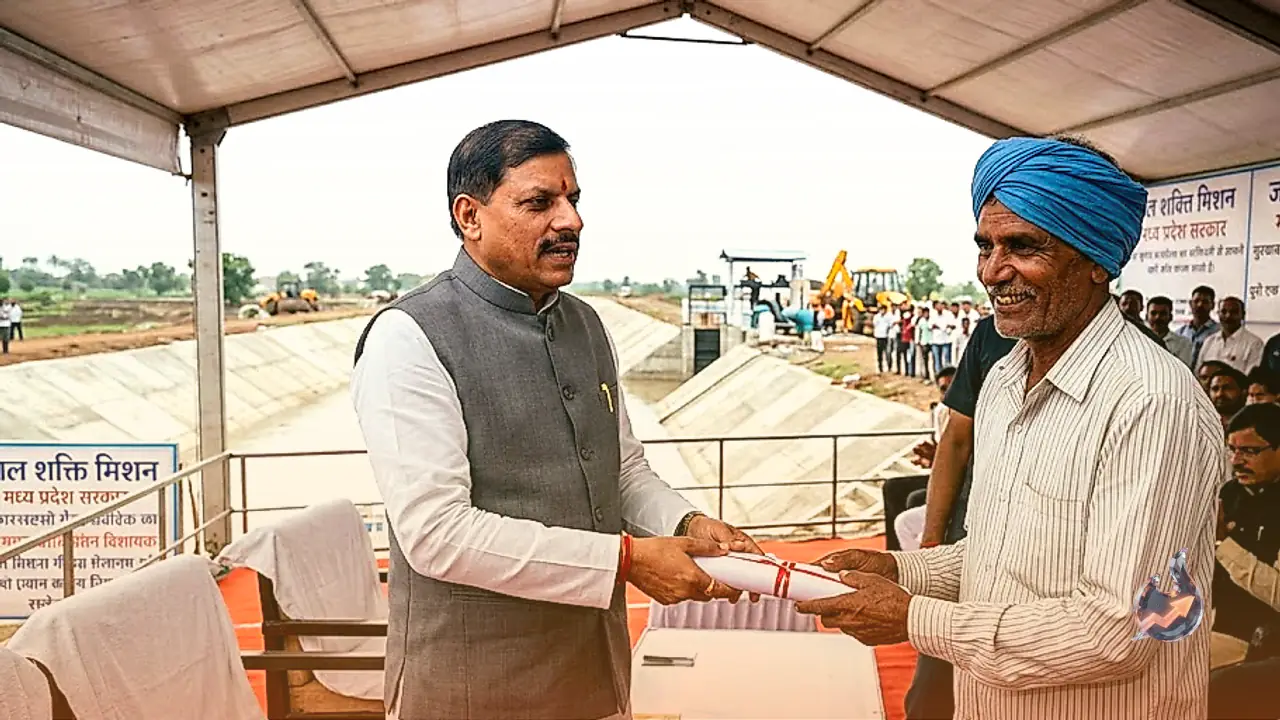

In an effort to accelerate statewide infrastructure expansion, agricultural productivity, and administrative decentralisation, the Madhya Pradesh Cabinet has cleared major financial proposals amounting to more than Rs 13,790 crore. The decisions, taken during a cabinet meeting chaired by Chief Minister Dr Mohan Yadav on September 22, encompass long-term projects spanning rural irrigation, power capacity additions, assembly-level sporting facilities, the judicial system, commercial taxation reforms, and specialised medical education.
Major Allocations for Agricultural Irrigation Networks
Addressing agricultural water security in central and western districts, the council of ministers cleared multi-year funding extensions for key irrigation undertakings scheduled between April 1, 2026, and March 31, 2031. For Rajgarh district, the Suthaliya irrigation project secured an allocation of Rs 262.63 crore to sustain operations across the five-year cycle. This undertaking focuses on building micro-irrigation capability across 40,000 hectares of farmland to maximize water application efficiency and reduce conveyance losses.
In Neemuch district, the Jawad-Neemach pressurized micro-irrigation project received approval for Rs 4,197.58 crore across the same five-year window spanning April 1, 2026, to March 31, 2031. Operating as a closed-pipe pressurized distribution network, this project routes water directly to field borders. The technical objective centers on pairing pressurized distribution with water-saving micro-irrigation to curb losses and substantially improve crop yields in the region.
A third major water initiative, the Parbati Rinsi irrigation project in Rajgarh district, was granted Rs 507.23 crore for the upcoming five years from April 1, 2026, to March 31, 2031. This venture involves the construction of a dam structure designed to establish fresh irrigation capacity covering 48,000 hectares of cultivated land in Rajgarh. Together, these three water conservation initiatives represent an expansive multi-year capital commitment to rural water security.
Long-Term Power Procurement and Grid Stability
To support growing industrial, agricultural, and domestic electricity demands across Madhya Pradesh, the cabinet authorized MP Power Management Company Limited to initiate procurement procedures for 2,800 megawatts of thermal power. This competitive bidding will operate under the Design, Build, Finance, Own, and Operate (DBFOO) model guidelines issued by the Ministry of Power, Government of India.
The power will be sourced through competitive tendering from existing operational facilities, ongoing construction sites, and newly proposed greenfield or brownfield thermal generation projects located within Madhya Pradesh. This updated arrangement also incorporates an earlier approval from January 24, 2025, which originally covered 900 megawatts of thermal power procurement; following the cancellation of that prior tender, the volume has been absorbed into the comprehensive 2,800-megawatt framework. The Managing Director of MP Power Management Company has been authorized to oversee all procedural and regulatory steps in compliance with regulatory commission orders.
Assembly-Level Sports Complexes with Helipads
Under the Department of Sports and Youth Welfare, an in-principle sanction of Rs 962.50 crore was granted to construct and manage sports facilities across 140 assembly constituencies. These sites will officially be designated as Chief Minister Sports Complexes, providing dedicated training and athletic spaces for rural and suburban youth.
A notable feature of the design involves embedding a permanent helipad within the central athletic field of each complex. This infrastructure will facilitate smooth transit for helicopters operating under the PM Shri scheme, creating logistical redundancy for administrative mobility and emergency access while offering localized community recreation.
Strengthening Court Operations and Free Legal Representation
Substantial budgetary continuity was approved for the state's legal and judicial apparatus, aligning with the 16th Finance Commission cycle running from April 1, 2026, to March 31, 2031. The Gram Nyayalaya scheme was granted Rs 554.61 crore to maintain village courts, funding salaries, allowances, and day-to-day administrative expenditures for judges and administrative staff tasked with resolving rural litigation locally.
For underprivileged citizens seeking legal recourse, the MP Legal Aid and Legal Advice Board received Rs 524 crore for the 16th Finance Commission period. Concurrently, the establishment and operation of Family Courts under the Registrar of the Madhya Pradesh High Court received Rs 1,000 crore to handle domestic and matrimonial disputes. The High Court (Charged) allocation, which supports non-votable core administrative and judicial expenses of the principal court, was approved at Rs 2,015.60 crore for the same multi-year window.
Modernisation of Commercial Taxation and Registry Systems
The cabinet extended six schemes overseen by the Commercial Tax Department for five financial years from 2026-2027 through 2030-2031, with a cumulative sanction of Rs 969.87 crore. The breakdown allocates funding across revenue recording, digital archiving, and public office infrastructure.
Among the individual programs, the Sampada e-registry platform received Rs 62 crore, while expenditures related to stamp sales were allotted Rs 664 crore. Stamp manufacturing and procurement expenses were approved at Rs 175 crore, and departmental asset maintenance received Rs 12.50 crore. An additional Rs 46.37 crore was assigned to the Digital India Land Records Modernization Programme, while Rs 10 crore was sanctioned for constructing and expanding district and sub-registrar office buildings across the state.
Academic Expansion at Indore Dental College
Addressing specialised medical education, the cabinet approved 13 new medical teaching posts at the Government Dental College in Indore. The newly sanctioned cadre comprises one professor, 10 associate professors, and two assistant professors, with an estimated recurring annual outlay of approximately Rs 3.78 crore.
This faculty expansion is tied directly to a planned increase in dental training capacity. Bachelor of Dental Surgery (BDS) enrollment is slated to expand from 63 to 100 seats, while Master of Dental Surgery (MDS) seats will increase from 35 to 44. The measure aims to alleviate regional shortages of specialised dental surgeons and enhance clinical training standards.
Administrative Offices in Maihar, Pandhurna, and Singrauli
To bring water management and public engineering services closer to citizens, the cabinet established new operational offices for the Public Health Engineering Department in newly created districts. In Maihar district, a dedicated district-level office will be created with five permanent posts and two outsourced office assistants. Because the Uchehara development block was not included within Maihar district boundaries, Uchehara has been formally attached to the department's Satna sub-division.
In the newly formed district of Pandhurna, a corresponding district office was approved alongside five permanent positions and two outsourced support roles. Additionally, a sub-divisional office will be set up in the Chitrangi block of Singrauli district, staffed by three permanent personnel and one outsourced assistant, ensuring closer oversight of drinking water programs in the region.