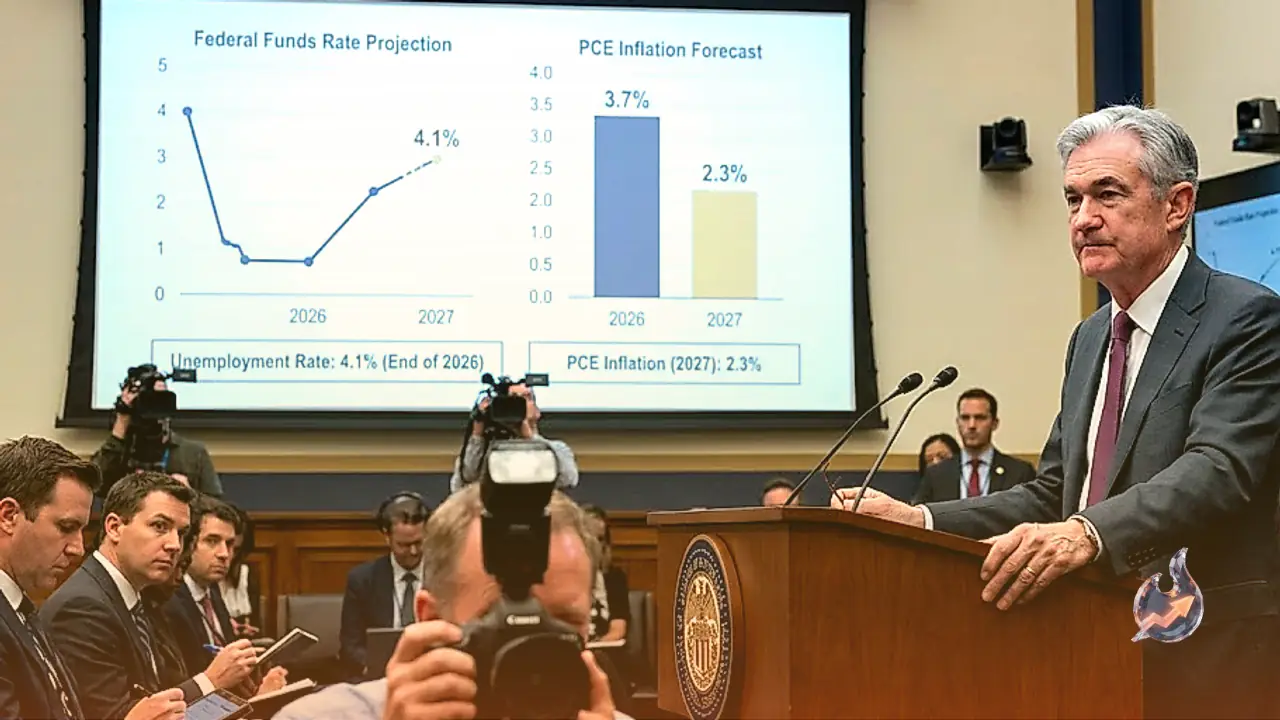
























Donald Trump's call for US interest rates at 1% or below landed only hours after the Federal Reserve lifted its benchmark rate by 25 bps. The market response put the demand in a stark policy context: the dollar remained firm, gold surrendered its intraday advance, and Chair Kevin Warsh's hawkish tone increased bets on additional rate increases before year-end.
Trump's demand meets a higher-rate decision
Trump wrote in a post that the appropriate level for US rates was 1% or less. The note arrived a few hours after the Fed's expected 25 bps increase, meaning markets had already absorbed the policy move before his message appeared. DXY held above 100.00, and its highest point for the session had been reached before Trump published the post.
The subsequent snapshot showed no further move in the index. Policymakers flagged inflation concerns, while Warsh adopted a notably hawkish tone during the press conference that followed the decision. Traders responded by increasing the odds of another hike before year-end.
Across the twelve months ending in June, the value of what Americans purchased overseas exceeded what they sold by roughly $743 billion. That imbalance leaves dollars in foreign hands, creating a pool that can be lent back to the US Treasury. If the gap disappeared, those buyers would be removed from the market that helps determine the borrowing costs Trump wants reduced.
The final agency that still assigned its highest rating to US debt withdrew that grade in May 2025. That rating change is part of the broader debt-market backdrop.
Gold gives up its intraday gain
Gold gave back the advance it had built during the session and moved into negative territory after the Fed's 25 bps decision. XAU/USD touched above $4,360 for a short time, then the earlier update showed a faster decline toward the $4,250 area as hawkish remarks reinforced expectations for more tightening. At the September 16, 2026 close-bell live snapshot, Gold stood at $4,303, with a -0.70% change from the previous close of $4,333.
The live price was inside the 52-week range of $3,661–$5,586. Volume was 1.27x the 20-day average. RSI(14) registered 40. MACD read -6.60 against a 29.94 signal, while the histogram was -36.53, leaving the technical bias bearish.
The moving averages pointed in the same direction. EMA20 stood at $4,425, EMA50 at $4,388, and EMA200 at $4,416; SMA50 was $4,312 and SMA200 was $4,551. Gold's $4,303 price was below all of them, placing it in a long-term downtrend, with a death cross because EMA50 was below EMA200.
Bollinger(20,2) set its lower and upper bands at $4,258 and $4,747, with a midpoint of $4,502, and Gold remained inside those bands. ADX(14) was 19, indicating weak or range-bound conditions. The Stochastic fast line was 7 versus a signal line of 10. ATR(14) measured 110.54, which serves as the daily-volatility stop-loss buffer; 20-day support was ~$4,273 and resistance was ~$4,755.
The main reference levels were Pivot $4,330, resistance R1 $4,386 and R2 $4,469, plus support S1 $4,246 and S2 $4,190. To track momentum, the Stochastic Relative Strength Index first climbed to the upper boundary of its range during the break. It then fell to the lower boundary even as price remained close to its high, before curling upward again. That peak predated Trump's post, and the index made no further move afterward.
Dollar strength spreads across currency pairs
Early in Thursday's Asian session, AUD/USD moved below 0.7100 as the Federal Reserve announcement sent the US Dollar sharply higher. The Fed delivered the expected 25 bps hike, while concern about inflation helped create a firmer dollar backdrop.
USD/JPY reached a new high for the week near 156.00 in early Thursday trading. The move followed the same 25 bps increase, and Warsh's hawkish press-conference remarks added to expectations for another tightening before year-end. Together, the pairs showed that dollar strength extended beyond DXY.
How interest rates reach borrowers and savers
Borrowers pay financial institutions interest for loans, while savers and depositors receive interest on funds held with those institutions. Those borrowing costs are shaped by base lending rates, which central banks adjust as economic conditions change. Their usual job is to keep prices stable, most often by aiming for core inflation near 2%.
If price growth slips under that goal, a central bank can lower its base rate to encourage borrowing and support economic activity. If price growth climbs well beyond 2%, the standard response is a higher base rate designed to cool inflation. The Fed's latest increase sits on the tightening side of that framework, while Trump's call envisions a much lower-rate endpoint.
Why a stronger dollar pressures gold
When rates rise, global investors often find the affected currency more appealing because they can earn more on funds placed there. That flow generally supports the currency's exchange rate.
Gold faces the opposite pressure because holding it means giving up the income available from interest-bearing assets or bank deposits. When rates rise, that opportunity cost increases. High rates also tend to lift the US Dollar, and because Gold is priced in Dollars, that exchange-rate channel adds downward pressure to the metal.
What the Fed funds rate tells markets
At its core, the Fed funds rate is the overnight lending price between US banks. The Federal Reserve announces it at FOMC meetings as a range rather than a single figure. For example, a 4.75%-5.00% range is represented in headlines by its upper boundary, 5.00%.
The CME FedWatch tool follows market expectations for future Fed funds rates. Those expectations influence how many financial markets position ahead of future Federal Reserve monetary-policy decisions. After this meeting, the central expectation was the possibility of additional hikes before year-end.
Japan's cheap funding advantage faces a possible shift
For more than a decade, Japan's exceptionally low rates supplied cheap financing for trillions of dollars in investments around the world. That made the Japanese Yen one of the least expensive funding currencies, even though most major economies raised interest rates and left Japan as the outlier.
The Bank of Japan is expected to tighten policy again this week, so the Yen's funding advantage may be entering a new phase. For global investors, the key issue is whether the rate difference that made Yen funding unusually cheap will remain stable after the expected move.
What comes next for rates and markets
The immediate focus is the gap between Trump's request for 1% or lower rates and the Fed's latest tightening step. Markets will also be watching inflation-driven hike expectations before year-end, Gold's live support levels, the dollar's strength, and any change in Japanese funding conditions. Each factor can shift the outlook for borrowing costs, currencies, and gold even though the Fed has already completed the 25 bps increase.