






















Pakistan's army chief Asim Munir believed that signing the Mecca Pact with Saudi Arabia and Turkey would mark him out as a shrewd geopolitical operator, but the move has spectacularly backfired on his own camp. The shockwaves from the pact have travelled across the Middle East, rattling the UAE so badly that it moved almost immediately to strengthen ties with Delhi. The sudden warmth between Saudi Arabia and Pakistan left the UAE visibly uneasy, and that unease pushed its security calculus firmly toward India.
The Old Saudi-UAE Rivalry
Saudi Arabia and the UAE have long been locked in a quiet contest for influence across the Middle East, each keen to be seen as the region's dominant power. Recently, the United States approved a defense package worth close to $5 billion, roughly Rs 41,000 crore, for Saudi Arabia. Around the same time, Saudi Arabia signed the Mecca Accord together with Pakistan and Turkey. That single step set off alarm bells in Abu Dhabi, because Saudi Arabia had just pulled nuclear-armed Pakistan and militarily strong Turkey into its own bloc, making it considerably more powerful. A simple rule of international diplomacy applies here: a rival's friend becomes a rival, and a rival's rival becomes a partner. For the UAE, the Saudi-Pakistan-Turkey trio fell squarely into that second category.
Munir's Haste Became India's Opening
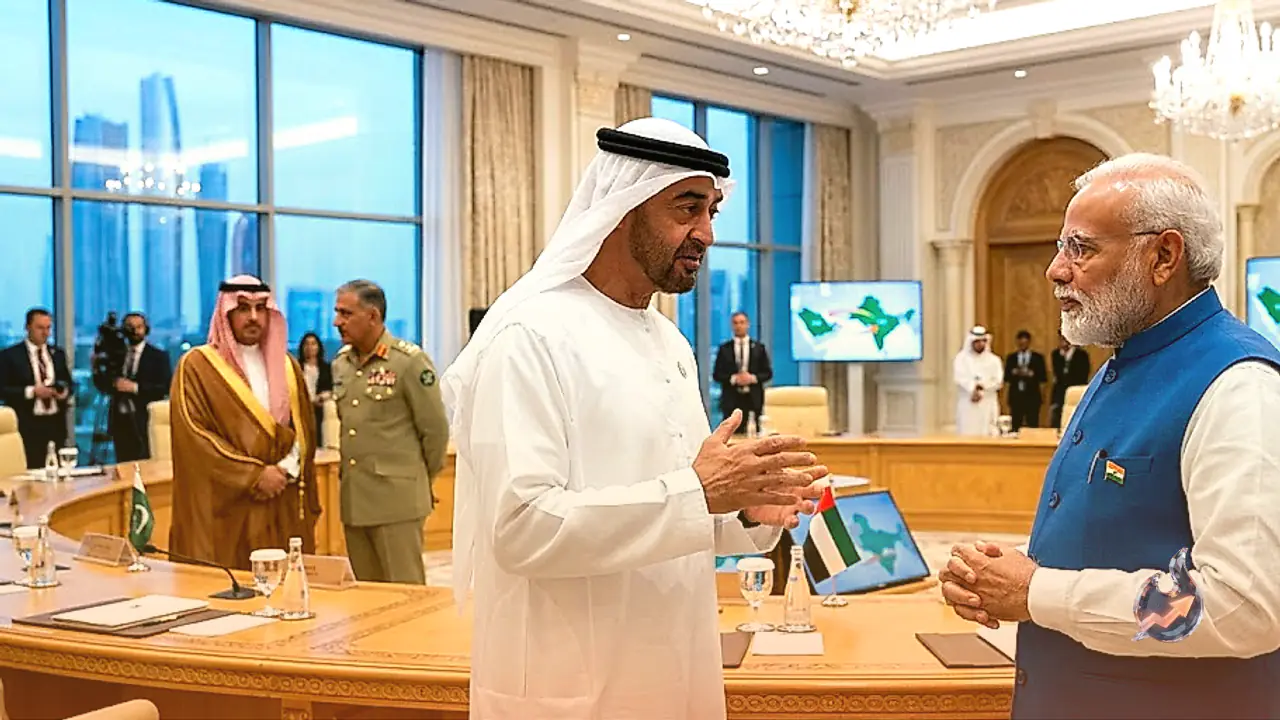
By aligning itself with the Saudi camp, Pakistan left the UAE feeling thoroughly insecure. Had Asim Munir not signed the Mecca Pact, the UAE would not have felt the need to lean toward India so quickly for its own security. That miscalculation by Munir worked directly in India's favour. Just as headlines were dominated by news of the Mecca Pact and the $5 billion US-Saudi deal, the UAE's Air Force chief arrived in India on a visit. That trip was no coincidence; it carried a clear message that if Pakistan and Saudi Arabia were forming a new grouping, the UAE was ready to stand alongside India's military strength and strategic depth. The visit also signalled that Gulf nations no longer want to depend solely on Western powers for their security, and are instead looking to build a direct relationship with an emerging military power like India.
How India Is Becoming West Asia's New Pivot
This entire chain of events has handed India an opportunity to deepen its footprint in West Asia that may not have come so easily otherwise. There are three big reasons behind this.
- Military and defense partnership: The UAE knows that India is the only power in South Asia capable of countering Pakistan militarily. India's air force, its advancing technology and its fast-growing defense exports make it a dependable and nearby option.
- Balancing the Saudi-Pakistan bloc: India is no longer just a market for buying oil. The UAE is using its ties with India to build fresh strategic balance, so it doesn't end up weaker against the Saudi-Pakistan-Turkey trio.
- A match of economic strength: The UAE has enormous investment capacity, while India brings a vast market, high-tech defense manufacturing and growing strategic power. Together, the two countries could turn this combination into a win on both the economic and strategic fronts.
The bigger picture is straightforward. Asim Munir set out to box India in and assert Pakistan's clout across the Middle East, but his own haste ended up pushing the UAE into India's lap. The more muscle Pakistan tried to flex through the Mecca Pact, the closer it drove the UAE toward India. As a result, the levers of Middle East politics are now sitting more firmly in India's hands than before, and the India-UAE closeness could soon translate into fresh defense deals and a deeper strategic partnership in the months ahead.