



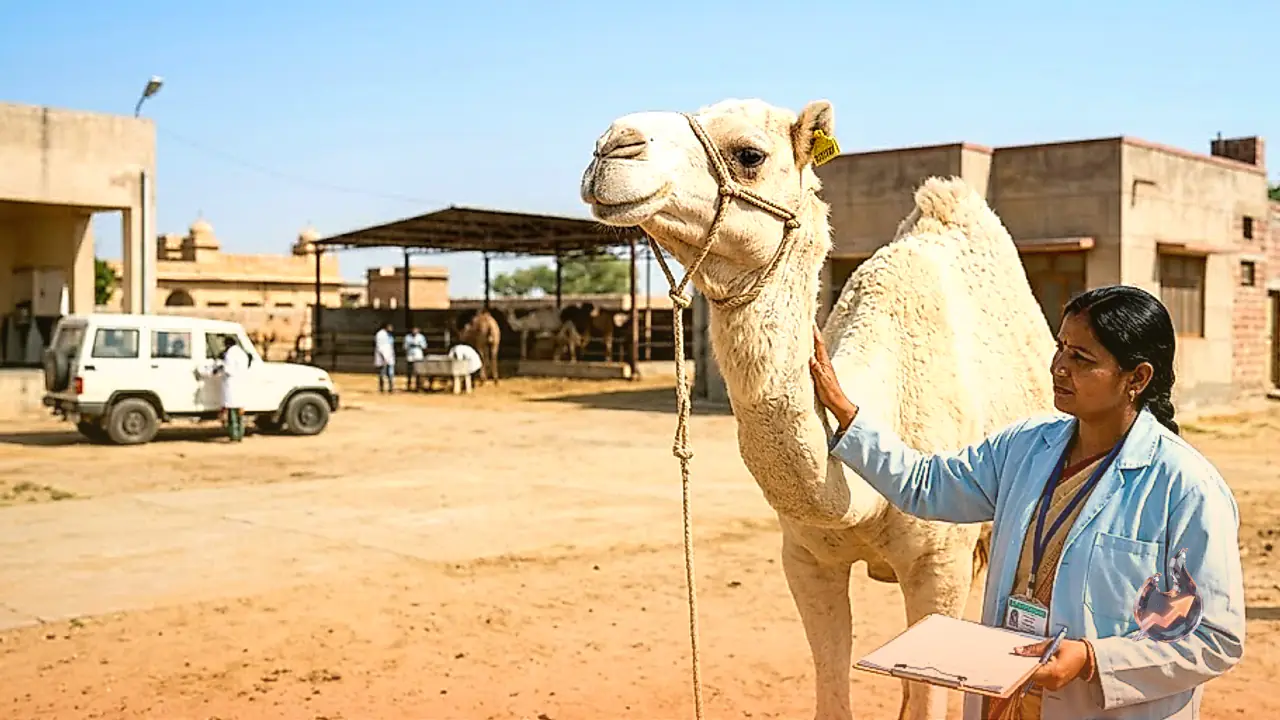

















In a concerning revelation for India's livestock biodiversity, the distinct white Malvi camel has reached the precipice of extinction. According to official data from the 2019 Livestock Census, the total national population of this rare breed has plummeted to a mere 102 individuals. Without timely and structured scientific intervention, this valuable genetic legacy risks becoming a relic confined solely to history books. Responding to this critical situation, the National Research Centre on Camel (NRCC) located in Bikaner, Rajasthan, has launched an intensive initiative to conserve and propagate the endangered species. The research institute has initiated a dedicated farm-based breeding framework to rebuild the Malvi camel population from the ground up.
New Conservation Drive: Farm-Based Breeding Launched with 12 Camels
To safeguard this irreplaceable genetic asset, the NRCC has put practical measures into motion. The center recently acquired 12 purebred Malvi camels, comprising 3 males and 9 females. These selected camels will form the foundational stock for a controlled pure breeding program conducted at the Bikaner research farm. Scientists anticipate that this systematic farm breeding model will enhance reproductive success while preserving the genetic purity of future generations.
Emphasizing the urgency of the effort, NRCC Director Dr. Anil Kumar Poonia noted that the institution has initiated targeted steps to preserve and multiply the vulnerable population. He stated, "Efforts are being made through the breeding program to save this endangered breed and increase its numbers." Principal Scientist Dr. Ved Prakash further explained that if the conservation campaign progresses as planned, it will not only boost the headcount of Malvi camels in coming years but also permanently secure this precious genetic heritage for the nation.
White Coat and Compact Stature: Key Traits of the Malvi Breed
Livestock experts highlight that the Malvi camel possesses physical and physiological attributes that set it apart from other Indian camel breeds. Its striking white coat and relatively compact body frame serve as its defining visual features. Beyond aesthetics, the breed demonstrates notable dairy utility, with a female Malvi camel capable of producing approximately four to five kilograms of milk per milking session.
Geographically, Malvi camels are indigenous to specific contiguous belts across Rajasthan and Madhya Pradesh. In Rajasthan, their traditional habitat spans the districts of Kota, Bundi, Jhalawar, and Baran. In neighboring Madhya Pradesh, they are historically raised across the Malwa region and adjacent districts, including Mandsaur, Neemuch, Ratlam, and Gwalior.
According to breed classification standards defined by scientists, whenever the total number of female camels in any breed drops below 300, the species is formally classified as endangered and threatened. With female Malvi camel counts far below this critical 300 benchmark, scientific conservation, managed breeding, and genetic preservation remain the only viable pathway to prevent complete extinction.
India's 9 Recognized Camel Breeds and Malvi's Critical Standing
India officially recognizes nine distinct camel breeds within its national livestock registry. This official list comprises Bikaneri, Jaisalmeri, Kutchi, Mewari, Jalori, Mewati, Malvi, Marwari, and Kharai. Among these nine breeds, the Malvi holds a unique status due to its characteristic white coloration, moderate build, and dangerously low numbers. The scientific conservation drive spearheaded in Bikaner offers a crucial lifeline to ensure this rare animal heritage endures for future generations.