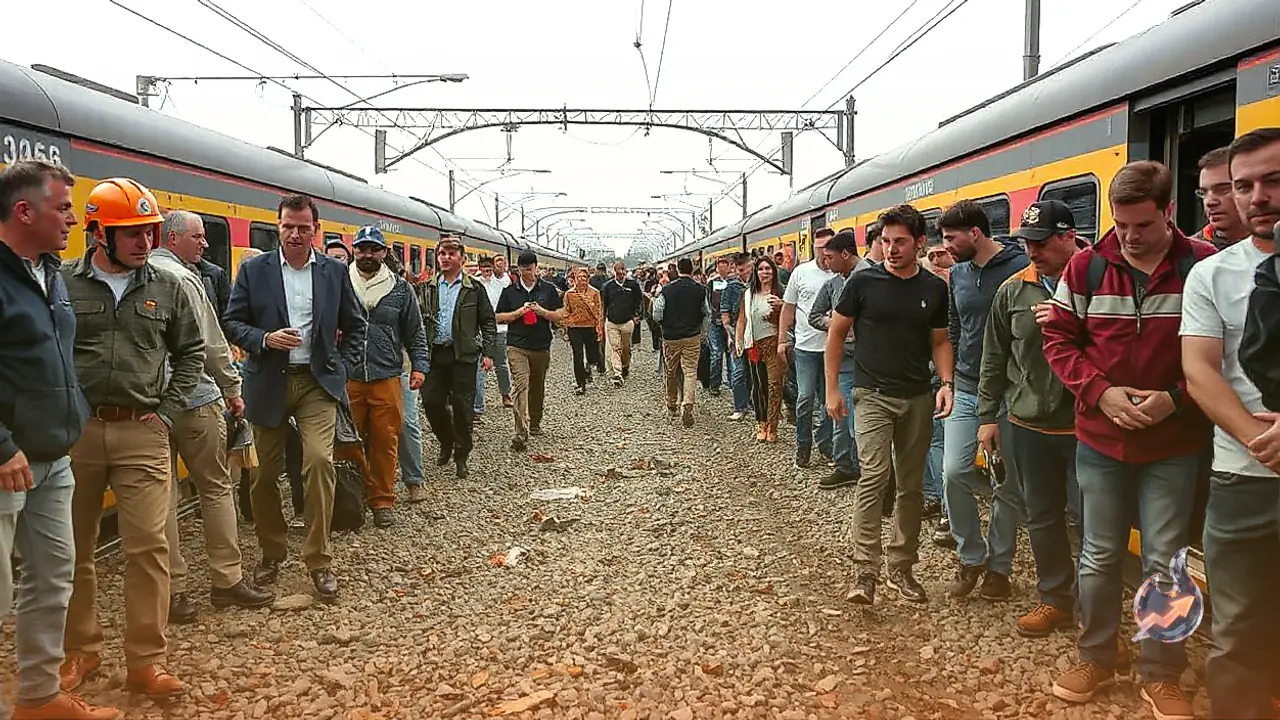


















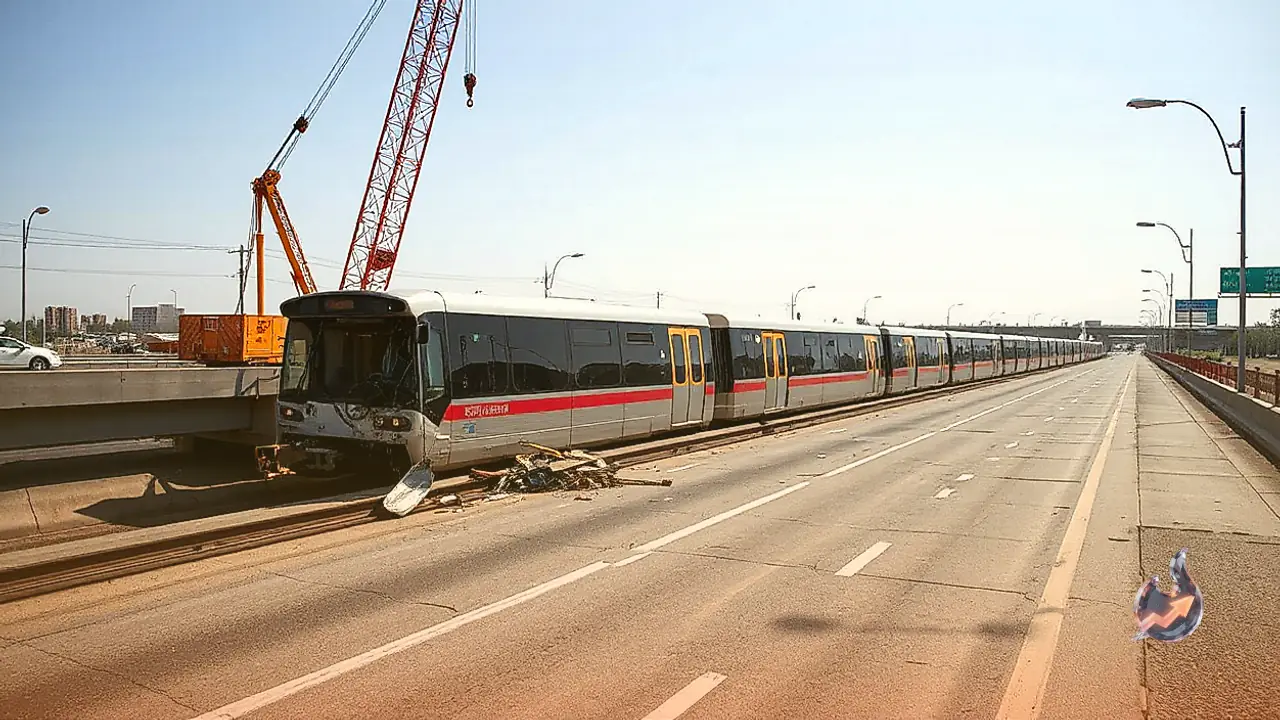

A severe collision involving a fully automated monorail train and a construction crane in São Paulo, Brazil, has reignited global concerns regarding the safety parameters of autonomous public transit. The incident occurred on Saturday, October 24, along Line 15-Silver in the Vila Prudente district. Operating entirely without an onboard driver, the train was traversing its elevated concrete guideway when it encountered a crane boom leaning across the path. Rather than slowing down or executing an emergency stop, the automated train proceeded at full operating speed and slammed directly into the machinery, dislodging heavy pieces of metal and concrete onto the active roadway below.
Video footage recorded at the location confirmed that the crane was stationary and already encroaching upon the guideway well before the train arrived. Despite the obstruction being clearly visible in the line of travel, the monorail failed to initiate braking in time. Fortunately, the passengers inside the carriages escaped serious injuries, and vehicles moving along the thoroughfare beneath the elevated structure narrowly avoided being crushed by falling debris. The narrow escape averted mass casualties but laid bare the operational vulnerabilities of automated transport when confronted with non-standard track obstructions.
The Architecture of CBTC and Driverless Monorail Operations
Monorail infrastructure diverges substantially from conventional railway networks. While traditional trains roll over twin parallel steel tracks laid across grade or bridge decks, a monorail navigates a single elevated beam fabricated from reinforced concrete or structural steel. The train's bogies feature specialized drive and guide wheels that grip the top and vertical flanks of the beam to maintain traction and lateral stability. In a driverless configuration, the front cabin operates entirely without a human locomotive engineer, relying instead on communications-based train control systems and centralized computing algorithms.
Under this setup, onboard processors, wayside track sensors, and a central operations room maintain continuous digital dialogue via radio frequencies or local wireless data links. The supervisory software determines the exact acceleration curve, cruise velocity, dwell time at passenger stations, and precise braking points along the entire route. Automation is deployed under the premise that it eliminates human vulnerabilities such as operator fatigue, distraction, medical emergencies, or inadvertent signal overshoots. However, these digital protocols function reliably only within strictly programmed scenarios, displaying acute shortcomings when atypical physical variables disrupt the corridor.
Pattern Recognition Limits in Identifying Atypical Track Hazards
The primary engineering vulnerability exposed in São Paulo lies in the system's reliance on fixed track sensors and standardized pattern recognition. Automated transit networks are exceptionally proficient at identifying standard operational conflicts, such as the presence of a preceding train on the same block or an active red signal. However, when an irregular foreign object intrudes into the clearance envelope, such as a fallen tree branch, dropped construction materials, or a steel crane arm, optical and radar sensors frequently fail to register the obstacle in time.
A human train operator monitors the line of sight continuously, possessing the cognitive adaptability to spot unusual foreign shapes or nearby construction movements from a substantial distance and apply emergency brakes manually. Computer systems, conversely, execute commands solely when incoming sensor feeds match established anomaly algorithms. In this accident, the monorail software failed to effectively interpret the crane boom as a physical barrier in its path, allowing the vehicle to drive into the obstacle without corrective intervention.
Evacuation Complications Along Elevated Transit Guideways
Because monorails run on narrow beams elevated several meters in the air on concrete pylons, mechanical failures or collisions create severe evacuation bottlenecks. On conventional ground-level rail lines, commuters can disembark directly onto the track ballast and walk to safety during an emergency. On an elevated monorail, opening carriage doors exposes passengers to significant vertical drops directly over active vehicular traffic or deep ravines.
In the event of an onboard fire, structural damage, or systemic computer shutdown, evacuating passengers from high elevations requires specialized external equipment, such as fire department crane platforms or auxiliary escape walkways. Without an onboard transit employee to direct the crowd, manage emergency exits, and maintain calm, the risk of passenger panic and stampedes increases dramatically during an elevated crisis.
Debris Hazards Over Urban Roads and the Need for Physical Safeguards
Monorail networks are deliberately designed to cut through dense urban centers, navigating directly above high-volume surface streets, highway intersections, and road overpasses. Consequently, any impact or structural failure on the elevated guideway directly endangers the population below. When the train collided with the crane in Vila Prudente, shattered glass, structural paneling, and jagged metal wreckage plunged onto the highway below. It was purely fortuitous that no motorists were crushed beneath the descending wreckage.
This hazard highlights the necessity of passive secondary protection around elevated alignments. Transit engineers frequently advocate for heavy-duty safety netting beneath elevated track sections, particularly where guideways span heavily trafficked motorways. Such physical barriers capture detached parts, shattered concrete, or dropped cargo before they strike pedestrians or fast-moving road traffic.
Network Fragility, Software Vulnerabilities, and Cyber Exposure
Fully driverless transit operations remain tied to uninterrupted central network connectivity and real-time data transmissions. This deep integration makes automated transit lines vulnerable to localized software glitches, central server crashes, latency spikes, and external cybersecurity intrusions. A minor software bug or temporary loss of telemetry can paralyze an entire transit line simultaneously.
More dangerously, corrupted control packets or misconfigured logic loops could theoretically issue conflicting routing or velocity instructions. Without a human driver in the cabin capable of physically cutting power or overriding digital controls via manual air brakes, the train remains entirely beholden to the validity of its remote automated inputs.
Balancing Pure Automation with Human Oversight and Next-Generation Sensing
The collision in São Paulo underscores that urban transit modernization cannot depend entirely on blind automation. When construction activities, maintenance machinery, or heavy cranes operate in close proximity to active automated corridors, human watchmen and manual override protocols must be integrated into the workflow to maintain visual safety buffers.
Furthermore, rolling stock operating autonomously requires retrofitting with multi-spectrum LiDAR arrays and artificial intelligence computer vision capable of mapping non-standard track intrusions up to 500 meters ahead. Bridging the gap between algorithm-driven efficiency and physical real-world unpredictability remains the ultimate challenge for the future of driverless urban rail.