

















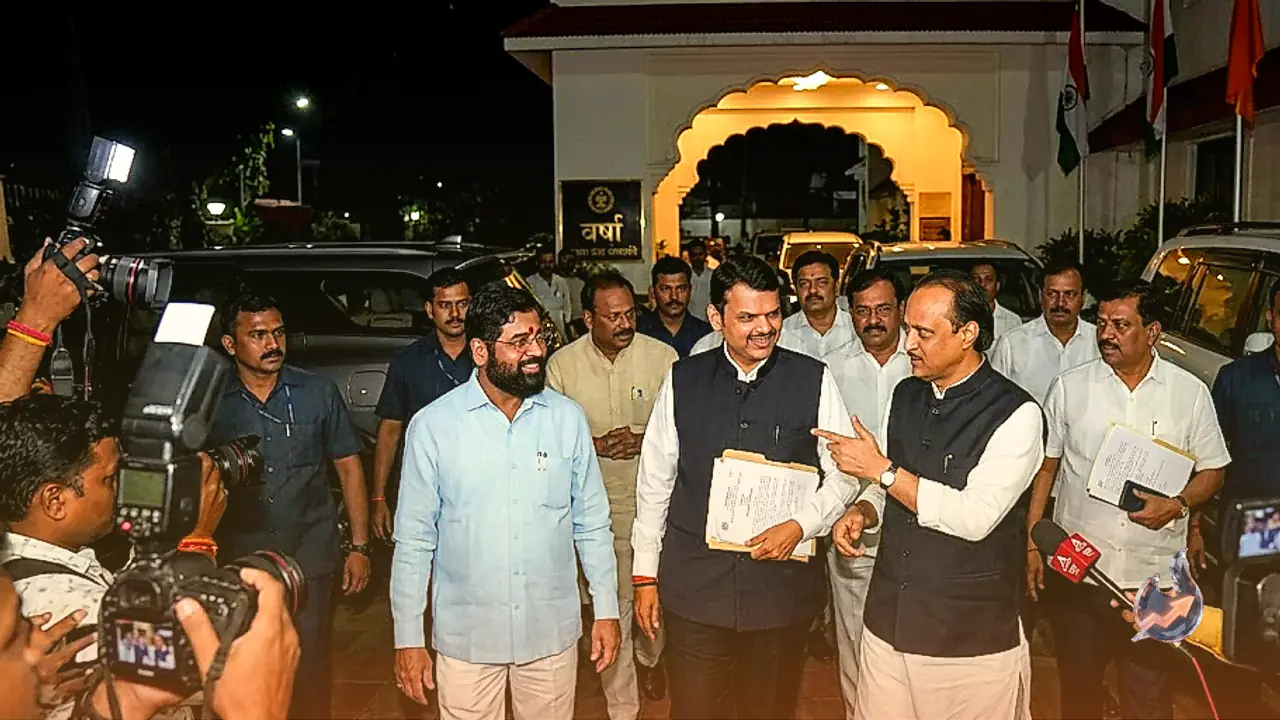

The political friction within the ruling Mahayuti coalition in Maharashtra has finally come to an end. A crucial coordination committee meeting held at the official residence of Chief Minister Devendra Fadnavis, named 'Varsha', successfully resolved the prolonged deadlock surrounding the distribution of various state corporations and boards. During this high-level discussion, it was agreed that positions across these entities will be distributed based on the total number of MLAs each constituent party possesses, with an official announcement expected to be made shortly.
Key Leaders Present At The Coordination Committee Meeting
Top leaders representing all three major partners of the alliance attended the session. Alongside Chief Minister Devendra Fadnavis, the Bharatiya Janata Party was represented by ministers Girish Mahajan and Chandrashekhar Bawankule. The Shiv Sena faction participated through prominent figures including Eknath Shinde, Uday Samant, Shambhuraj Desai, and Dadaji Bhuse. Meanwhile, the Nationalist Congress Party delegation featured Sunetra Pawar, minister Chhagan Bhujbal, Hasan Mushrif, and Sanjay Khodake, who collectively deliberated on the alliance's upcoming strategy.
Strict Timelines Set To Resolve Outstanding Disputes
To streamline administrative and political coordination, strict directives were issued during the meeting. Areas experiencing friction or ongoing disputes have been prioritized for swift resolution, with designated review meetings scheduled for every Tuesday to clear pending matters. The Chief Minister explicitly instructed that all lingering issues must be finalized and settled within the next month. Furthermore, names designated for chairperson and member positions across various state boards are to be finalized and dispatched immediately.
New Distribution Framework For DPDC Funds And Member Appointments
Financial distribution and operational management concerning the District Planning and Development Committee, known as DPDC, were also subjected to strict new protocols. Under the updated framework, ruling party MLAs will retain authority over 60 percent of member selections and fund disbursements within their respective DPDC jurisdictions, while the Guardian Minister will hold distribution rights over 30 percent of the allocated funds. Committees operating under the DPDC are mandated to maintain a comparable structural ratio. In constituencies where both a Guardian Minister and a ruling party MLA are present, this 60 percent share applies directly, while 20 percent allocations are reserved for ruling MLAs belonging to other Mahayuti allies. Legislators from the constituent alliance parties will independently execute member appointments for these DPDC panels.
Categorization Of Corporations And Proportional Allotment
State corporations have been systematically categorized into A, B, and C tiers to ensure an equitable distribution process. The most prominent and high-profile corporations fall under the A category, while the remaining entities are designated under B and C brackets. Since the Bharatiya Janata Party commands the largest legislative strength within the coalition, it will secure the largest share in the allocation of these boards and ruling DPDC committees. Following the BJP, Eknath Shinde-led Shiv Sena and subsequently the NCP will receive their proportionate shares. Additionally, directives have been issued to ensure smaller constituent allies of the Mahayuti receive appropriate representation in DPDC panels, fund distributions, and select board chairmanships or memberships.
Chandrashekhar Bawankule Responds To Leadership Speculations
Following the conclusion of the meeting, state minister Chandrashekhar Bawankule launched a sharp counterattack against opposition remarks, firmly dismissing any speculation regarding leadership changes by stating that the platform was never meant for such discussions.
This is no platform to change leadership, the opposition is in too much of a hurry to replace leadership.
The minister further emphasized that the people of Maharashtra have delivered a decisive and overwhelming mandate to the Chief Minister, with the public standing firmly behind Devendra Fadnavis following the election of 235 MLAs. Dismissing opposition rhetoric as baseless, he remarked that political opponents feel threatened because their agendas cannot thrive as long as the current leadership remains at the helm.
Upcoming Electoral Strategy And Alliance Unity
Chandrashekhar Bawankule noted that the meeting also evaluated preparations for upcoming Legislative Council or MLC elections as well as local municipal body polls. Discussions further focused on effectively fulfilling public commitments made during the campaign cycle. Reaffirming alliance cohesion, he stated that the coalition will contest every forthcoming electoral battle collectively as a united front.