
















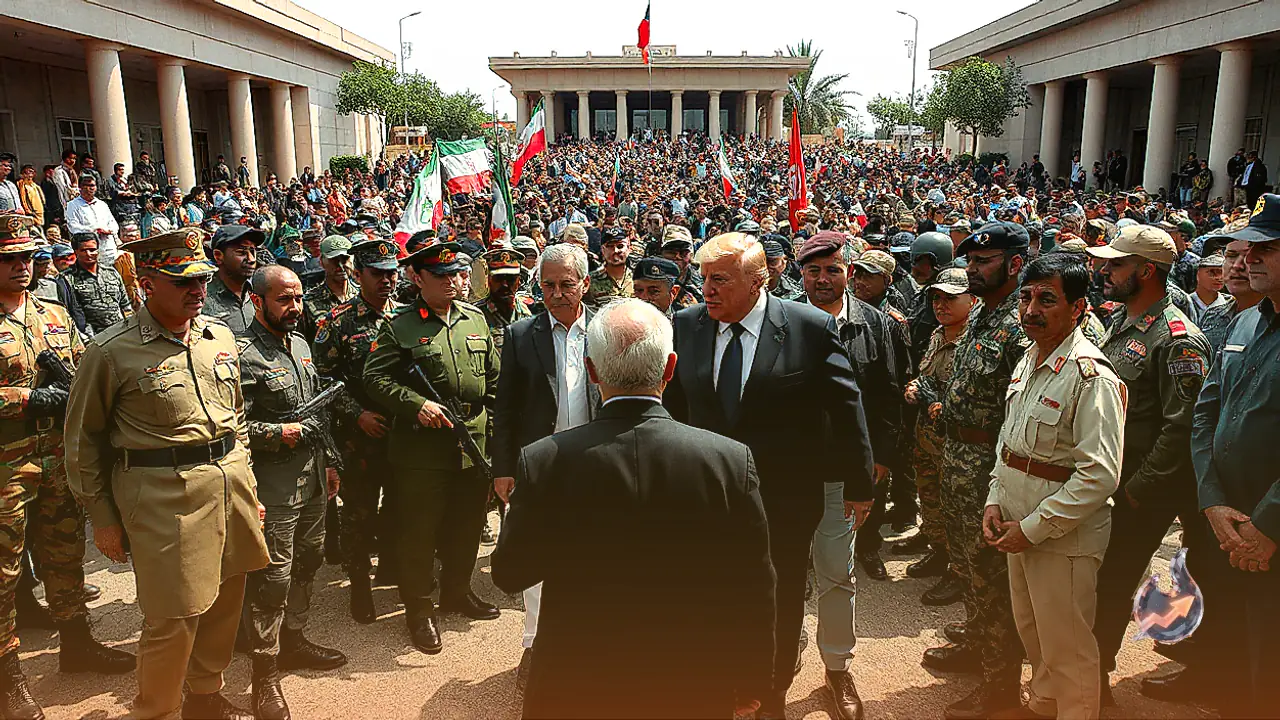

Tensions across the Middle East have climbed to a precarious high as escalating rhetoric from Tehran and Washington underscores an increasingly rigid confrontation. Iran's Supreme Leader Mojtaba Khamenei convened a high-stakes strategy meeting with senior armed forces commanders, instructing them to deliver an immediate and decisive retaliation against any potential offensive actions. The Iranian leadership emphasized that when responding to security risks, national forces should operate unconstrained by conventional geographical boundaries, even as diplomatic channels attempt to keep back-channel negotiations alive.
Retaliatory Mandate and Battlefield Readiness
Mojtaba Khamenei made the directives from the high-level commanders' conference public through a sequence of posts on X. Outlining the operational posture expected from the defense apparatus, he set a sharp mandate for handling external hostility.
"Every level and every kind of threat must be met immediately, effectively, and without any geographical boundaries."
The Supreme Leader stressed that if adversaries launch renewed military strikes or terror operations, the timing and precise conditions for concluding the conflict will be decided exclusively by the armed forces and the people of the Islamic Republic. In his guidance to defense chiefs, Khamenei noted that maintaining a state of intelligent combat readiness is vital to deterring external provocations. He also called for urgent enhancements in the country's defense technology sector, ensuring that all military branches remain capable of absorbing and countering multi-faceted threats.
The White House Stance: No Haste for a Resolution
In contrast to Tehran's defiant military posturing, the administration in Washington conveyed a remarkably unhurried outlook regarding an exit from the hostilities. Addressing reporters inside the Oval Office, US President Donald Trump remarked that the United States feels no urgency to wrap up the ongoing military engagement, describing the standoff as something outside ordinary conventions. Despite months of sustained clashes and parallel diplomatic engagements yielding no durable settlement, Trump asserted that strategic time favors American leverage.
"This is war, but it is not a normal war. We have been there for 7 months."
The US President pointed toward severe administrative and financial distress within Tehran, observing that the Iranian government is failing to disburse wages to its military rank and file as well as its police units. According to Trump, these internal pressures are driving Iranian officials to seek continuous dialogue, yet Washington intends to let events run their course without rushing into an immediate truce.
Draft Proposal Focuses on Enriched Stockpiles and Maritime Transit
Alongside the aggressive official exchanges, an early framework draft aimed at advancing formal discussions between the two nations has begun to circulate. The initial proposal suggests mechanisms to neutralize concerns regarding Tehran's highly enriched uranium inventory, presenting options to either transfer the sensitive stockpiles to an agreed third country or lower their enrichment grades to non-critical levels.
A critical clause in the draft blueprint addresses global shipping infrastructure, stipulating that the Strait of Hormuz must be unblocked and reopened to international commercial transit within 7 days of reaching a preliminary pact. Given that this maritime corridor serves as the world's most critical transit route for international petroleum trade, any enforceable agreement guaranteeing secure navigation would carry far-reaching consequences for international energy markets.