






















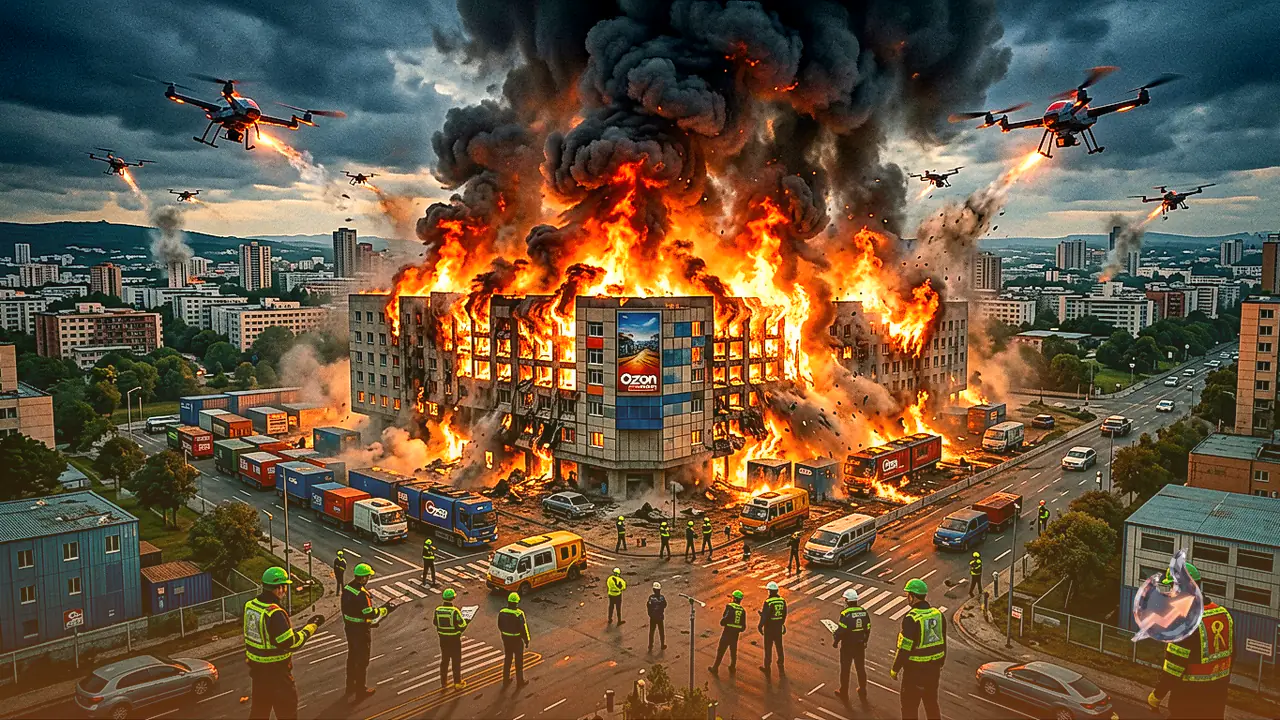

Warehouses operated by Ozon, Russia's second-largest online retailer, have sustained extensive damage following a coordinated wave of Ukrainian drone strikes targeting multiple southern logistics facilities. The company confirmed that its facilities situated across the southern regions of Krasnodar, Dagestan, Stavropol, and Adygea caught fire, resulting in multiple injuries among staff during the overnight assaults.
Devastation Across Multiple Southern Hubs
In Makhachkala, located within the southern region of Dagestan, a drone attack triggered a fierce blaze at an Ozon logistics centre at around 05:00 local time, equivalent to 02:00 GMT on Monday. This followed an earlier major fire reported at another of the company's large logistics centres in the city of Krasnodar, positioned 700 kilometers or 435 miles to the east of the Dagestan site. According to the Russian defence ministry, three children lost their lives in Krasnodar as a consequence of the Ukrainian drone raid. Maria Lvova-Belova, Russia's children's rights commissioner, specified that the victims were aged 13, 15, and 16, while six additional children were rushed to local hospitals for medical treatment. Meanwhile, workers stationed at Ozon facilities in Adygeysk within the Adygea region and Nevinnomyssk in the Stavropol region were safely evacuated.
Broader Targeting of E-commerce Hubs
Ukraine has for weeks directed attacks at sites belonging to Wildberries, Russia's largest online retailer, framing the company as a legitimate military target due to alleged supply contributions to the armed forces, a claim categorically denied by Moscow. The strikes on Ozon come immediately after a facility belonging to the company in the Samara region was hit, which also left several workers injured. Following that earlier incident, the Ukrainian defence ministry asserted on Saturday that systematic strikes on dual-use storage facilities severely hinder enemy logistics and exert a negative toll on the broader Russian economy, noting that after hitting 15 major logistics hubs belonging to Wildberries, it was Ozon's turn. Simultaneously, in Ukraine's Odesa region, overnight strikes hit food storage locations and energy infrastructure, injuring five individuals according to regional head Oleg Kiper via Telegram.
Market Reaction and Kremlin Response
Financial markets reacted sharply to the security escalation. Shares in Ozon tumbled by as much as 12% on the Moscow Exchange during Monday morning trading, while shares of its principal shareholder, private equity firm AFK Sistema, dropped by nearly 13%. When questioned regarding potential state assistance for Ozon, the Kremlin stated that it was actively collaborating with business representatives to formulate various support options amidst this challenging situation. Established in 1998, Ozon stands as one of Russia's pioneer online retailers, trailing only Wildberries in total scale with delivery boxes and pick-up posts stationed nationwide, often sharing pick-up points where both company logos are prominently displayed side by side.
Deep Economic Dependence and Marketplace Model
The escalation has brought the reality of the ongoing conflict directly to ordinary Russian citizens. Widely characterized as Russia's Amazon, Ozon and Wildberries service an estimated 85% to 90% of the country's economically active population. In numerous remote settlements lacking traditional retail infrastructure, residents rely heavily on these platforms to procure essential clothing and household appliances. Unlike traditional retailers that sell merchandise directly, both Ozon and Wildberries operate primarily as marketplaces connecting independent vendors with buyers across Russia, managing storage, transport, and payment processing. Consequently, a significant portion of the losses incurred from the warehouse fires falls directly upon these independent commercial sellers rather than the corporate entities alone. While the Kremlin continues to deny that online retail infrastructure is utilized for military supply chains, Russian President Vladimir Putin warned on Saturday that Ukraine had opened Pandora's box by targeting economic infrastructure, vowing that Moscow would retaliate against Kyiv's most sensitive economic sectors as hostilities persist.