






















Major infrastructure developments initiated to enhance urban living standards in Noida have turned into prime examples of administrative negligence and wasteful public spending. A series of ambitious civic projects, backed by massive budgetary allocations, now stand completely defunct or severely compromised owing to poor conceptualization, faulty engineering, and prolonged maintenance lapses. Facilities designed to boost sports, public transit, and pedestrian safety have failed to yield any tangible benefits for residents, leaving hundreds of crores in public funds unutilized.
Unfulfilled Dreams of International Stadiums and Track Infrastructure
Upgrades and renovation work at the Noida Cricket Stadium in Sector-21A have consumed nearly 350 crore rupees over the years. Despite this substantial expenditure, the venue remains far from eligible to host international cricket events. Basic structural requirements mandated by the Board of Control for Cricket in India and the International Cricket Council, including permanent spectator seating and professional floodlighting systems, remain incomplete. Consequently, no major international or high-profile domestic tournament has taken place here, depriving both local athletes and sports enthusiasts of a world-class venue.
Within the same Sector-21A sports complex, a synthetic athletics track was developed at an estimated expenditure of 2.9 crore rupees. However, the project turned out to be fundamentally flawed as it was constructed to a length of just 300 meters instead of the mandatory 400-meter international standard. Because standard athletic competitions cannot be conducted on a non-standard 300-meter circuit, athletes training at the venue mockingly labelled it the eighth wonder of the world. The track remains largely useless for professional competitive events despite the significant outlay.
White Elephant Bus Terminal and Unusable Skywalk Connection
Designed to overhaul local public transportation, an eight-story modern city bus terminal was constructed in Sector-82 at a cost of approximately 158 crore rupees. Built with extensive parking facilities for 40 buses, 100 taxis, and 522 private cars, the facility was formally inaugurated but never brought into active operational service. Today, both public buses and commuters are completely absent from the multi-story complex, making this multi-crore investment an idle structure that contributes nothing to the city's transit network.
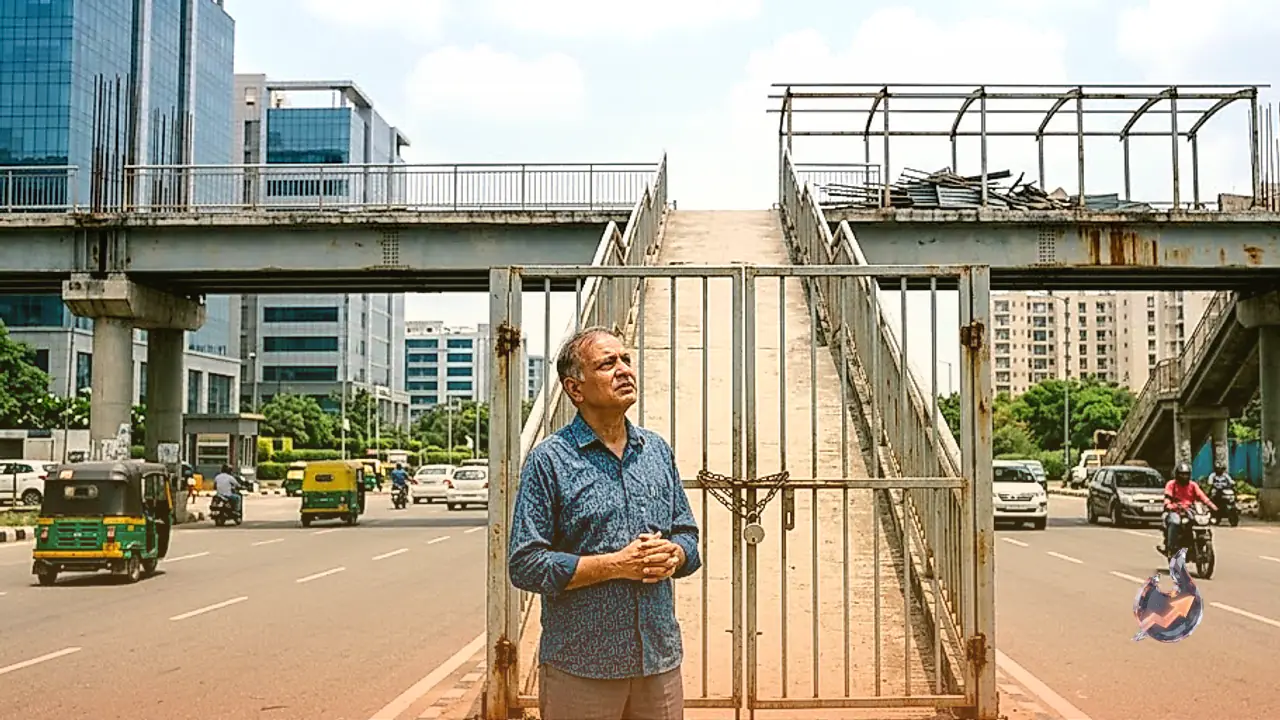
Similarly, a skywalk built to connect the Sector-51 and Sector-52 Metro stations stands as a textbook example of mismanaged urban engineering. Initially estimated at a modest budget of a few crore rupees, design modifications and construction hurdles pushed the final expenditure above 42 crore rupees. Near the completion phase, project engineers realized that a structural beam and wall of the metro station directly blocked the intended walkway. This critical oversight completely rendered the skywalk non-functional, leaving commuters forced to navigate narrow footpaths measuring 2.5 to 3 meters alongside heavy vehicular traffic.
Hazardous Underpass Engineering and Severe Indoor Fire Safety Risks
To ease congestion between Sector-51 and Sector-71, a 780-meter-long six-lane underpass was initiated in June 2019. Its original estimated cost of 52.58 crore rupees escalated to 59.35 crore rupees due to delays before it finally opened to the public in November 2021. However, sub-standard construction quality has led local drivers to dub it a hazardous stretch. The road surface across both lanes is extremely uneven, creating severe vehicle jumps and accident risks if speeds exceed 20 to 30 kilometers per hour.
Meanwhile, the Noida Indoor Stadium in Sector-21A, constructed at a cost of around 100 crore rupees, faces serious safety concerns. A recent inspection led by the Chief Fire Officer revealed that the facility lacks a valid Fire No Objection Certificate (NOC). Inspectors discovered multiple fire safety systems completely non-operational inside the complex. With hundreds of young sports enthusiasts visiting the indoor venue daily, the absence of active fire protection infrastructure poses severe safety hazards.
Wasted Public Funds on Open Gyms and Idle E-Cycle Docking Stations
To promote community wellness, the Noida Authority invested approximately 15 crore rupees to establish 66 open-air gyms across urban sectors and an initial phase of 15 villages. Due to a complete absence of ongoing maintenance, most of these facilities have deteriorated completely. Exercise equipment at numerous locations is either broken or missing, and residents in several villages now use the remaining metal frames to dry laundry rather than for fitness routines.
Lastly, an eco-friendly mobility initiative featuring 62 e-cycle docking stations was introduced across the city on a Public-Private Partnership (PPP) model at a cost of 1.5 to 2 crore rupees. While the Noida Authority constructed the physical infrastructure, private vendors were tasked with fleet operations and maintenance. Low user adoption, operational friction, and insufficient revenue streams ultimately led to the project's demise, leaving all 62 docking stations entirely inactive today.